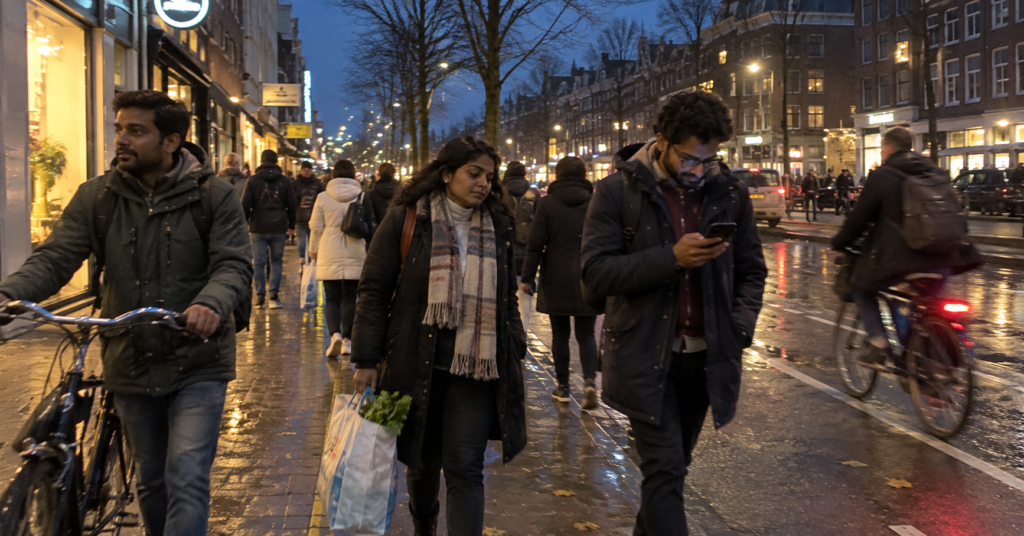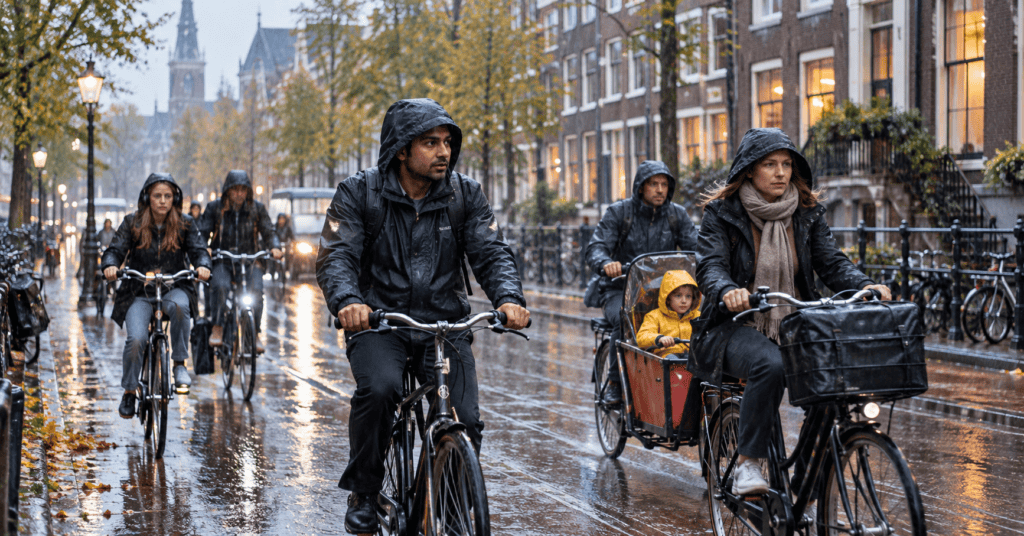
At first, cycling through cold Dutch rain when you could simply stay home can seem faintly ridiculous. Then you notice that everyone else has already put on a raincoat and left. Perhaps there is something useful hidden inside one of the Netherlands’ favourite responses to bad weather.
You know the weather. It is not raining. But it is not, not raining. Proper monsoon-like rain would be easier. Instead, there is a persistent diagonal drizzle, the wind has somehow chosen the direction directly opposite your destination, and Buienradar suggests that waiting another 20 minutes will achieve absolutely nothing. You have somewhere to be. There is an obvious solution? Cancel.
Then a Dutch person looks at you as though you have proposed shutting down Schiphol.
“Je bent toch niet van suiker?”
You’re not made of sugar, are you?
The first few times you hear this, it sounds like one more entry in the enormous catalogue of mildly strange Dutch expressions. But live here long enough and the phrase begins to reveal something more interesting. It isn’t really about rain. It is about deciding how much power inconvenience gets to have over your life.
Yes, the Dutch have apparently been saying this for more than a century
Niet van suiker zijn — “not to be made of sugar” — has been documented in Dutch writing as far back as 1914. Its broader meaning was to be tough rather than delicate or easily discouraged. Later examples increasingly make the connection to rain explicit. In a 1960 example collected in Marc De Coster’s Woordenboek van Populair Taalgebruik, a character dismisses the possibility that a woman won’t come because it is raining: she isn’t made of sugar.
The logic is wonderfully simple. Sugar dissolves in water. You do not. Therefore, just face your fears and get on with it.
Today, the expression is closely associated with perhaps the most Dutch combination imaginable: rain plus bicycle. The Dutch Cycling Embassy uses the saying to describe the habit of continuing to cycle when the weather turns wet, while international students and residents regularly encounter it after expressing entirely reasonable objections to getting soaked on their way somewhere.
One international resident writing for the Dutch student housing organization DUWO described arriving from Saudi Arabia, where heavy rain could close schools because the infrastructure was not built for it. Three years into her life in the Netherlands, she had gone from being the recipient of “je bent niet van suiker gemaakt” to saying it to others herself. That may be the real Dutch integration exam. Not the language test, not knowing which bin the plastic goes into this month. The moment somebody complains about the rain and you become the person telling them to cycle anyway.
The interesting part isn’t the rain
There is a tempting but slightly silly interpretation of all this: Dutch people are exceptionally tough humans who have transcended meteorology. They haven’t. Researchers studying cycling behavior in the Netherlands find exactly what common sense would predict: temperature, precipitation, and wind affect whether people cycle. Rain is still rain. But there is an interesting distinction.
Research using years of bicycle-count data on Dutch cycle paths found recreational cycling is much more sensitive to weather than utilitarian cycling. In other words, bad weather may make people less interested in going for a pleasant bicycle ride, but it has less influence on cycling that serves an everyday purpose. That distinction gets surprisingly close to the philosophy hidden inside you’re not made of sugar.
Nobody is claiming that rain is pleasant. However, what expats need to understand is that the rain doesn’t mean that you can skip your commitments.
A rainy recreational ride? Maybe skip it.
Getting to work? Put on a raincoat.
Cold outside? Wear another layer.
Twenty minutes by bicycle? Twenty minutes is still twenty minutes. Plans do not automatically become optional because the conditions stopped being ideal.
The useful Dutch lesson isn't that discomfort is good. It's that discomfort and impossibility are two very different things.
That sounds obvious when written down. In everyday life, we are remarkably good at confusing the two.
Moving countries can scramble your definition of “bad weather”
For Indians moving to the Netherlands, there is another layer to this. The weather in India isn’t merely about whether you need a raincoat. Depending on where you live, extreme heat, monsoon rainfall, flooding, air pollution, or poor drainage can genuinely change how sensible it is to travel. When I was a kid, the first monsoon rain almost always meant the school would be off.
And later, when I was working in Hyderabad, heavy rain meant flooded streets and enormous traffic jams. “It is raining” was a perfectly rational reason to change the plans. Indian internationals interviewed by the Leiden International Center described climate as one of the adjustments involved in moving from India to the Netherlands. One recalled arriving from a tropical climate in February and finding the Dutch winter physically unfamiliar. Her partner eventually developed an affection for cloudy Dutch weather although cycling in the rain remained beyond his enthusiasm. There is something familiar in that adjustment.
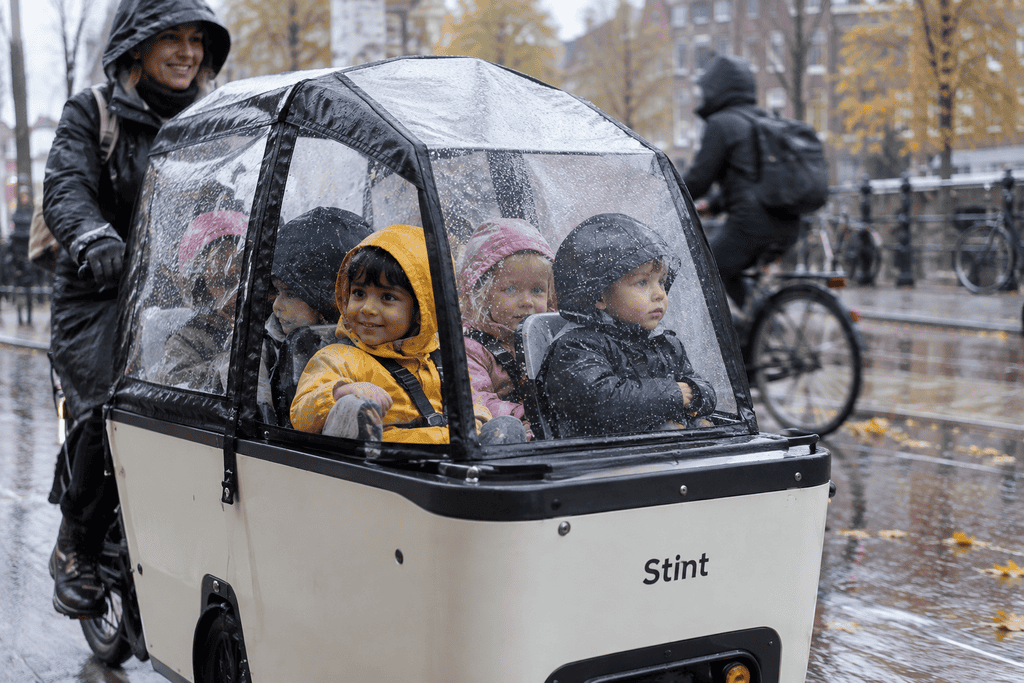
Your first Dutch winter can make perfectly ordinary activities look unreasonable. People are cycling children to school at 8 am in the darkness. Someone is jogging. A parent has put a toddler in a rain suit and apparently decided that playground plans remain in effect. Meanwhile, you are looking through the window thinking: These people know they can stay inside, right?
Over time, your calibration shifts. In my experience, it takes one and a half fall seasons. The first fall right after a pleasant (or, in 2026 and 2027, extreme) summer seems too dark, rainy, and a good excuse to cancel dinner plans or just order groceries via the Picnic app. But when you spend the coming winter, going through autumn, which still puzzles you, and a hot relief in the summer for two and a half weeks, the weather shifts, and you realize you can’t keep making the same excuse. Your calibration shifts, not because you become Dutch, and certainly not because Dutch weather becomes pleasant. You simply become better at distinguishing conditions that require adaptation from conditions that require cancellation.
That distinction is much more useful than pretending not to mind the rain.
The infrastructure deserves some credit too
The Dutch don’t continue cycling in bad weather simply because generations of stern mothers have produced unusually weatherproof children. They can do it partly because the environment makes ordinary life possible in mediocre weather. A separated bicycle path does not stop rain falling on your head, but it makes cycling through that rain considerably less daunting than sharing a chaotic road with cars. Reliable public transport provides another option. Buildings are heated. Appropriate clothing is readily available. And a country accustomed to wet conditions is generally designed around the expectation that rain will occur.
That matters.
Culture often gets credit for behavior that infrastructure quietly makes possible. Your gemeente and Rijkswaterstaat ensure that even after a night full of rain at -3 degrees, the black ice dissolves as soon as the temperature rises. So perhaps je bent niet van suiker works because the Dutch response to inconvenience is often not simply endure it. It is the whole system of preparing for it, designing around it, and then ensuring that the life goes on.
Raincoat. Waterproof trousers. Bike lights. Buienradar. Proceed. That is a more interesting form of resilience than pretending conditions don’t exist.
There is a surprisingly useful philosophy hiding here
This is where the phrase becomes bigger than cycling. Much of life is lived under less-than-ideal conditions. You don’t feel completely prepared for the Dutch class. Go anyway. Nobody you know is going to the event. Go anyway. It’s dark at 4.45pm and leaving the sofa seems like a serious strategic error. Sometimes, go anyway.
You have moved somewhere new and still don’t feel entirely comfortable speaking the language, cycling through rush hour or showing up alone. Being uncomfortable is not necessarily evidence that you shouldn’t be doing something. There is an important difference here between forcing yourself through everything and refusing to make perfect conditions a prerequisite for ordinary life. The latter is surprisingly liberating. Because perfect conditions are rare. Especially in the Netherlands.
But sometimes you should absolutely stay home
There are limits to Dutch weather stoicism. If KNMI is issuing serious weather warnings, this is not the moment to demonstrate your cultural integration by battling a storm on an omafiets. For code orange thunderstorms, KNMI explicitly advises postponing travel where possible and notes that severe thunderstorms are particularly dangerous for cyclists. For code red, the advice is considerably simpler: stay inside. Similar warnings apply during dangerous winds and severe icy conditions. There is a broader limit too.
You’re not made of sugar can be useful when it challenges unnecessary avoidance. It becomes less charming when it dismisses somebody else’s genuine limits. Illness is not laziness. An unsafe journey is not character development or a part of KNM exam. And occasionally, cancelling something because the weather is miserable is simply one of the advantages of being an adult with access to WhatsApp. Resilience becomes foolishness when enduring discomfort becomes the objective rather than a side effect. All you have to do is ask yourself – Does this actually stop me, or do I just wish the conditions were nicer?
Maybe this is what becoming slightly Dutch looks like
There are more visible signs of integration. You acquire opinions about which supermarket has acceptable hagelslag. You learn to schedule coffee three weeks in advance. You discover that lekker can apparently describe food, weather, sleep, cycling, a holiday, and an administrative meeting that finished early. But some changes are quieter. One day, you stop expecting the weather to cooperate with your plans. The forecast says rain. Of course it does. You check Buienradar anyway, discover that the rain will continue for the foreseeable future, look at the bicycle outside and experience the brief internal negotiation that has become part of life here. Then you put on your jacket. Perhaps integration isn’t when you start eating hagelslag. It’s when you look at the rain, swear quietly, and leave anyway.
Sources
- De Coster, Marc. Woordenboek van Populair Taalgebruik: niet van suiker zijn. View source
- DUWO. Living like the Dutch while living in the Netherlands. View source
- Dutch Cycling Embassy / Bicycle Dutch material on cycling in rain. View source
- Thomas, Jaarsma & Tutert. Exploring temporal fluctuations of daily cycling demand on Dutch cycle paths: the influence of weather on cycling. View research
- Helbich, Böcker & Dijst. Geographic heterogeneity in cycling under various weather conditions: Evidence from Greater Rotterdam. View research
- Leiden International Centre. Interview With an International: Tanima Bhattacharya & Sreejit Bardhan. View interview
- KNMI. Windstoten en storm. View KNMI guidance