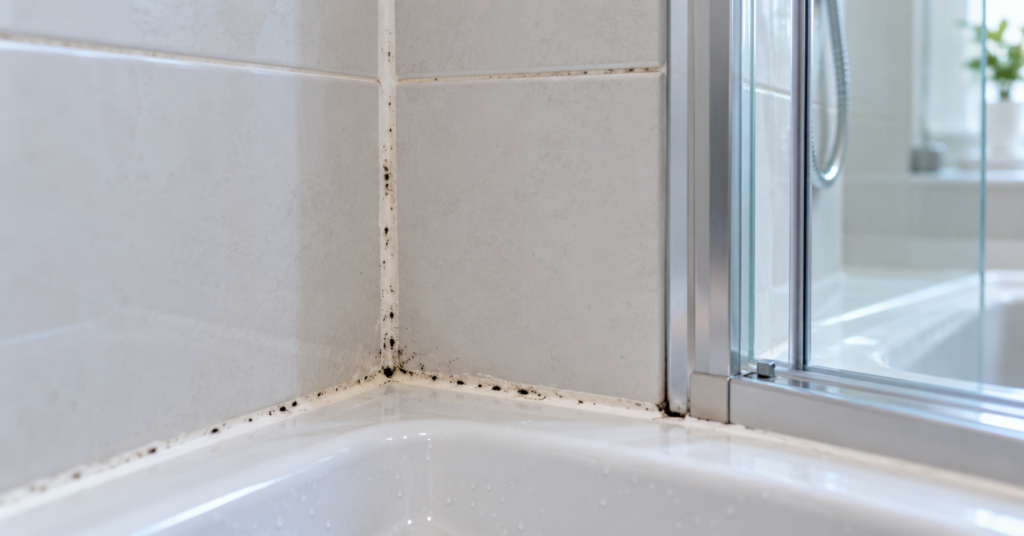
You clean the bathroom. A few weeks later, the black dots are back. If you have recently moved into a Dutch apartment, bathroom mould can become one of those unexpected little battles of life in Europe. The good news is that a few spots are usually manageable. The more important question is why they appeared in the first place.
are those black spots actually mould?
Tiny black or dark grey spots commonly appear around shower silicone, tile grout, ceilings, and damp corners. In a bathroom, mould is a likely explanation, particularly if the area regularly stays wet or you notice a musty smell.
But “black mould” is not the name of one particular dangerous fungus. Different kinds of mould can appear dark, and the color alone cannot tell you which species is growing there. The US CDC says identifying the precise type is generally unnecessary: visible mould should be removed and, more importantly, the source of the moisture should be addressed.
So you do not need to panic because something is black. You do need to deal with it.
Why Dutch bathrooms are so good at growing it
Mould needs moisture. And a bathroom provides plenty of it.
A hot shower fills the room with water vapour. That moisture then condenses on colder walls, ceilings, grout and windows. If it cannot escape quickly enough, surfaces stay damp and mould gets an opportunity to grow.
This becomes particularly noticeable during the colder months, when homes are heated while outside walls and windows remain cold.
Dutch health authorities recommend treating mould with what they call the four V’s in Dutch: removing it, reducing moisture, ventilating and heating. Ventilation should not only happen when you happen to remember to open a window; homes with mechanical ventilation are designed to ventilate continuously.
That can be one of the less obvious adjustments when moving countries. A bathroom may have no window at all, but instead depend on a mechanical extractor that is supposed to keep running.
How to remove a small patch of bathroom mould
If you are dealing with a few spots on an otherwise intact bathroom surface, you can normally start by dealing with it yourself.
- Ventilate the bathroom while cleaning. If you have mechanical ventilation, turn it to its higher setting.
- Use a mould-removal product approved for use in the Netherlands. Look for terms such as schimmelreiniger or schimmelbestrijder. Dutch public-health guidance recommends following the product instructions rather than improvising increasingly powerful chemical cocktails.
- Dampen the affected area before removing the mould. This reduces the amount of material that becomes airborne while you clean it.
- Never mix cleaning products. In particular, do not start combining chlorine or bleach products, acids, soda and other cleaners. Some combinations can produce harmful gases.
- Look at the material underneath. Mould sitting on a hard tiled surface is different from mould that has penetrated silicone, plaster, wood or other material. If the black staining is deep inside an old silicone seal and refuses to disappear, replacing the sealant may make more sense than repeatedly attacking it with cleaner. Dutch GGD guidance similarly notes that affected kit, wood or plaster may have to be removed rather than simply wiped.
And no, painting over it is not a fix. The mould can simply grow through again if the underlying moisture remains.
The 30-second habit that matters more than another cleaning spray
Once the shower is finished, get the water out of the room rather than waiting for all of it to evaporate.
Use a shower squeegee — the humble trekker you will see in Dutch shops — on the walls and floor. Run the extractor during and after the shower and leave it running until the bathroom has dried. If there is a suitable window, use it for ventilation as well.
GGD guidance specifically recommends wiping water from bathroom surfaces after showering and keeping mechanical extraction running long enough for the moisture to disappear.
Also check whether the ventilation is actually working. A vent hidden under months of dust or an extractor that barely moves air will not become more effective because you have bought a stronger mould spray.
One counter-intuitive Dutch recommendation: don’t automatically open the bathroom door and send all that steam into the rest of your apartment. GGD guidance recommends keeping the door towards the hallway closed while the bathroom is humid where proper extraction is available, so that moisture does not simply migrate into bedrooms and living areas.
If the mould keeps coming back, stop blaming your cleaning
This is where the problem changes.
Mould that disappears after cleaning but repeatedly grows back in the same area may indicate that the bathroom is staying too damp. That could be because of insufficient ventilation, but persistent problems can also come from a leak, water penetration, cold surfaces or another building defect.
And this is not an obscure problem in Dutch housing. Government figures from WoON2024 show that moisture and mould problems were reported by 31% of households in private rental properties. Among households experiencing mould, 59% reported it in the bathroom.
So if you have been ventilating, drying the bathroom and cleaning appropriately and the same large patch keeps returning, the answer is not necessarily to buy bottle number four.
When should you tell your landlord?
If you rent, tell your landlord when the mould is substantial, keeps returning despite normal ventilation and cleaning, appears to come from a leak or structural problem, or your bathroom simply has no adequate way to ventilate.
Take photographs and report the issue in writing.
Dutch public-health guidance says landlords should address inadequate ventilation facilities and building-related causes such as leaks or penetrating moisture.
The Dutch government also advises tenants to report defects such as moisture, leaks and mould to their landlord in writing. If a landlord does not resolve a serious maintenance problem, tenants may in some circumstances take the issue to their municipality or the Huurcommissie.
That distinction matters: cleaning normal bathroom deposits is part of living in a home. Fixing a leaking wall or inadequate building ventilation is something else entirely.
Is bathroom mould dangerous?
It deserves attention, but not a horror-movie soundtrack.
The World Health Organization links persistent indoor dampness and mould with increased respiratory symptoms, allergies and asthma. Dutch public-health guidance also notes that bathroom mould generally creates less exposure than mould in rooms where people spend many hours, such as bedrooms and living rooms — but recommends removing it and preventing it from returning.
People with asthma, allergies or sensitive lungs should be particularly cautious about significant mould exposure and may want someone else to handle the cleaning.
For everyone else, the useful response to those first black dots is considerably less dramatic: remove them, dry the shower, check the ventilation and see whether they come back.
If they do, you may no longer have a cleaning problem. You may have a housing problem.