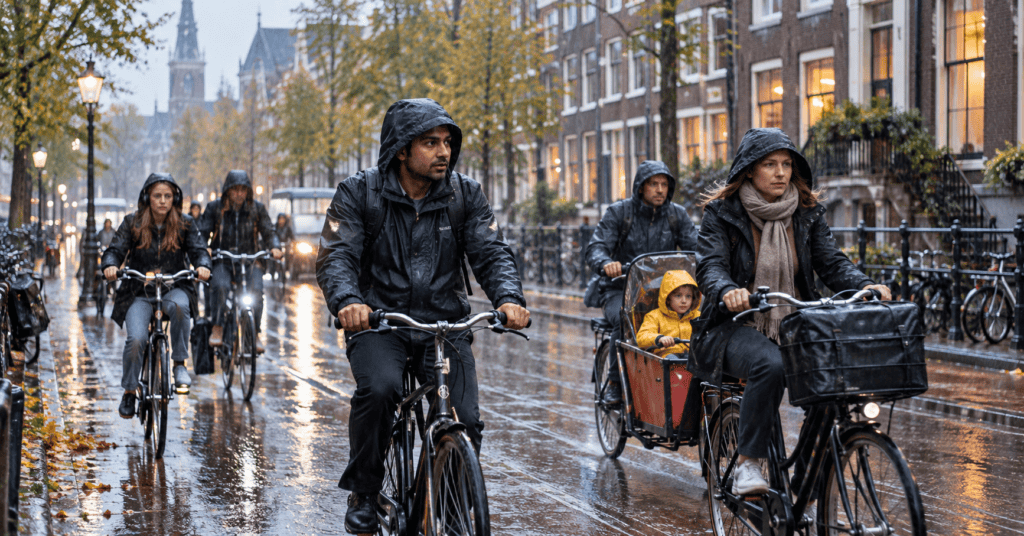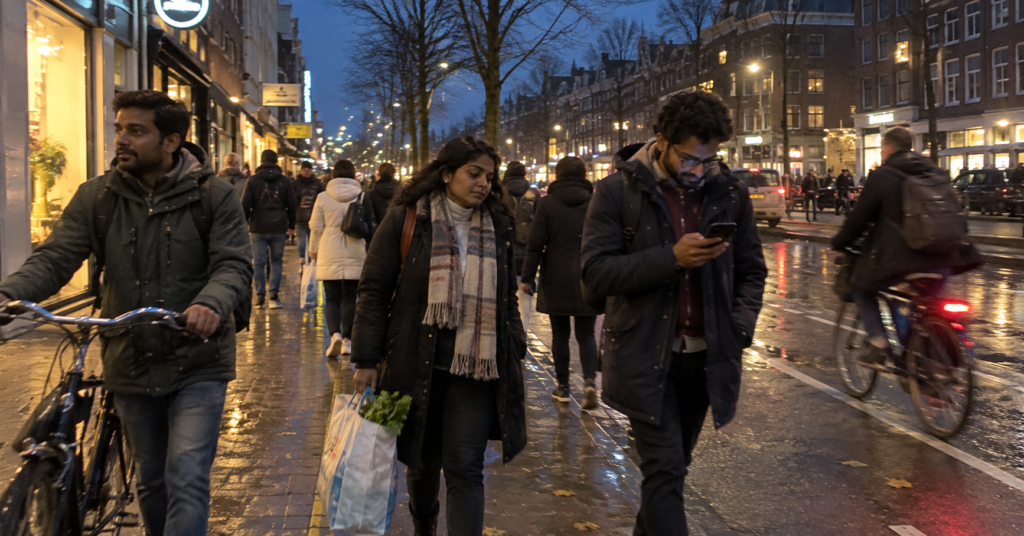
Small disclaimer before Europe files a complaint: not all 11 apply everywhere. Some are aggressively Dutch. Some are very German. Most will nevertheless be recognised by at least one Indian currently wearing a jacket indoors.
1. The sun disappearing while you’re still answering emails
What you say: “I actually like having proper seasons.”
What you mean: “Why does it look like midnight at 4:17 pm?”
The cold is manageable. You buy thermals. You discover Uniqlo. You eventually stop trying to look fashionable in January. But the darkness it different. There is something psychologically offensive about looking out of the office window after your afternoon chai and discovering that the day has apparently been canceled.
And no, you are not imagining it. On 1 December 2026, the sun sets at about 3:56 pm in Berlin and 4:30 pm in Amsterdam.
Then comes June, when you find yourself telling relatives in India, with suspicious pride, that it is 10 pm and still light outside. Stockholm syndrome, but astronomical.
2. A cold sandwich being considered a complete lunch
What you say: “Honestly, something light at lunch is better.”
What you mean: “This is what I used to eat while waiting for lunch.”
Bread. Cheese. Perhaps a cucumber. Done. If you grew up believing lunch should involve something hot, preferably accompanied by dal, sabzi, rice, roti, curd, pickle and a brief argument about whether you have eaten enough, the Northern European office lunch can take some processing.
This is particularly Dutch. A February 2026 discussion in r/Netherlands about colleagues eating a simple cheese sandwich for lunch attracted hundreds of comments from locals and bewildered foreigners alike.
Eventually you adapt. By “adapt,” we mean you bring yesterday’s rajma in a glass box and quietly occupy the microwave for three minutes.
3. Making an appointment to see your own friends
What you say: “Thursday the 17th works for me.”
What you mean: “Are we having drinks or conducting bilateral negotiations?”
You meet someone you genuinely like. “Let’s do something soon!” Excellent. Out come two calendars. One person has climbing on Tuesdays. Someone’s parents are visiting next weekend. You are in Paris the weekend after that. There is a birthday on the 12th.
And there it is: a coffee, 23 days from now, 14:30–16:00.
Coming from a social culture where “come over” can occasionally mean today, this level of organization initially feels absurd. A few years later, however, something disturbing happens. A friend calls and asks if you want dinner tonight.
You stare at the phone. “Tonight? Like… with no notice?”
Congratulations. Europe has entered your bloodstream.
4. Cycling in weather that is clearly telling you not to cycle
What you say: “You just need the right clothes.”
What you mean: “My socks are wet.”
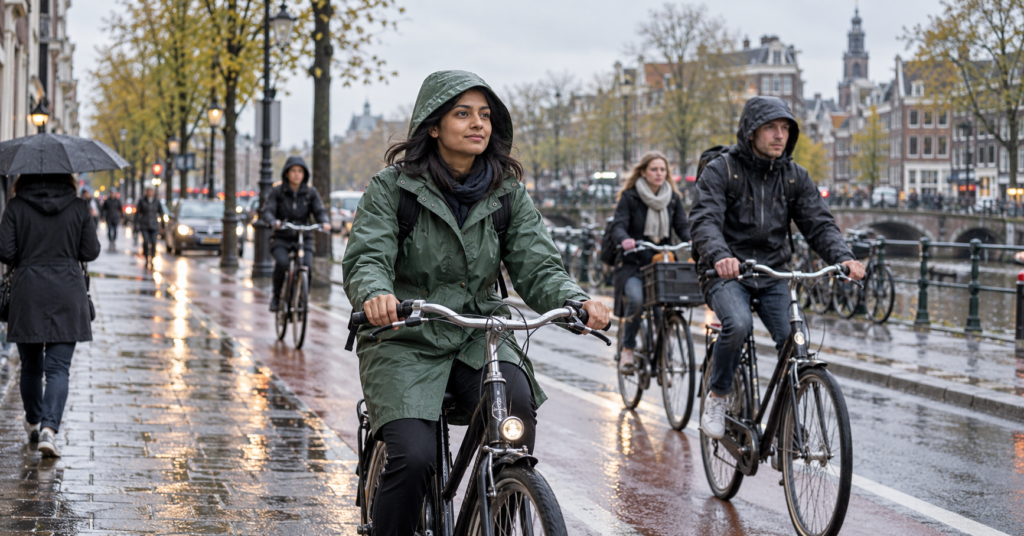
The first time you see someone cycling through horizontal rain while carrying two children and a week’s groceries, you assume there has been some kind of emergency. There has not. It is Wednesday. In the Netherlands, cycling is not merely a pleasant Sunday activity. Bicycles accounted for 27% of all trips in 2023, according to CBS. Eventually you become one of these people.
Rain? Cycle. Wind? Cycle. Cold? Cycle.
Rain plus wind plus cold? Complain extensively. Then cycle.
Integration is when you complain about the weather while cycling through it.
5. Receiving a payment request for €2.87
What you say: “I actually like how fair everything is.”
What you mean: “You have sent me an invoice for half a bowl of nachos.”
For Indians in the Netherlands, few things announce cultural integration quite like the first microscopic Tikkie. Someone pays €15.40. Your phone buzzes. €7.70 requested.
No drama. No “arre leave it.” No five-minute fight over who gets the honour of paying. Just accounting.
And once the system gets you, it gets you completely. In a recent discussion about Tikkie etiquette, the overwhelmingly straightforward advice was essentially: pay the bill and send the payment request afterwards. Six months later, you are sending someone €3.25 yourself. Your ancestors are watching in silence.
6. Needing advanced training to throw away one yoghurt pot
What you say: “Waste separation is important.”
What you mean: “IS THIS PLASTIC OR RESTAFVAL?”
Paper here. Glass there. Food waste somewhere else. Bottles go back to the supermarket. This packaging looks like cardboard but contains a mysterious inner layer apparently designed specifically to test immigrants.
You have two master’s degrees and ten years of professional experience, yet occasionally you stand in front of four bins holding an empty container and experience complete intellectual paralysis. Then you do what every responsible adult does: look around to see what your neighbours did.

7. Sunday being an actual day when shops can be closed
What you say: “It’s nice that people get a proper day off.”
What you mean: “I HAVE NO ONIONS.”
This particular trauma is heavily German. You wake up on Sunday. You decide to cook properly. You open the fridge. Nothing.
Fine. Supermarket.
Except this is Germany, where most shops are closed on Sundays, with exceptions such as some bakeries, petrol stations and shops at major railway stations.
Every Indian newcomer makes this mistake once. Experienced residents make it roughly four more times. By year three, you have developed the Saturday-evening supermarket instinct of somebody preparing for a minor natural disaster.
8. Someone saying exactly what they mean
What you say: “I appreciate the direct communication.”
What you mean: “Could you perhaps hide the truth inside three compliments first?”
This can actually become one of the things Indians like about Northern European workplaces. But the adjustment is real. No elaborate cushioning. No “perhaps we could maybe consider…” when the answer is simply no.
One Indian professional living in the Netherlands described learning that “No, I cannot” is a complete sentence, and said she had come to appreciate the freedom of being more direct at work. Liberating? Yes.
The first time your colleague looks at something you spent six hours making and says, “I don’t think this works”? Still hurts a little.
9. Being cold inside a building that has functioning heating
What you say: “Nineteen degrees is perfectly comfortable.”
What you mean: “Why am I dressed for Manali inside my own living room?”
Europe teaches you that heating is not binary. There is no: ON / OFF
There is instead:
18.5°C
19°C
19.5°C
and a domestic policy debate about whether increasing it by another half-degree represents financial irresponsibility.
Eventually you adapt your wardrobe accordingly. Outside: coat. Office: sweater. Home: hoodie. Bed: socks, blanket and the unresolved question of why your parents’ house in India somehow felt warmer in December despite possessing absolutely no central heating.
10. “It’s nearby” meaning a 20-minute walk
What you say: “Yeah, that’s walkable.”
What you mean: “There is transport. Why are we rejecting technology?”
Google Maps: 18 minutes walking. European friend: “Oh, that’s super close.” Indian brain: Define close.
At first you check the bus. Then the tram. Then perhaps Bolt. Eventually, you just walk. And this may be the most dangerous adaptation on the entire list, because you take it home with you.
You return to India, someone proposes taking the car for somewhere 900 metres away, and suddenly you are the irritating person saying: “Come on, guys. We can just walk.” That is when you realise what has happened. Not when you bought the rain trousers. Not when you started separating glass by colour. Not even when you sent your first €3 Tikkie.
That.
That is when Europe finally got you.
Which one are you still pretending to be used to?
And more importantly: what did we miss?
Send this to the friend who still refuses to accept that bread and one slice of cheese constitute lunch.