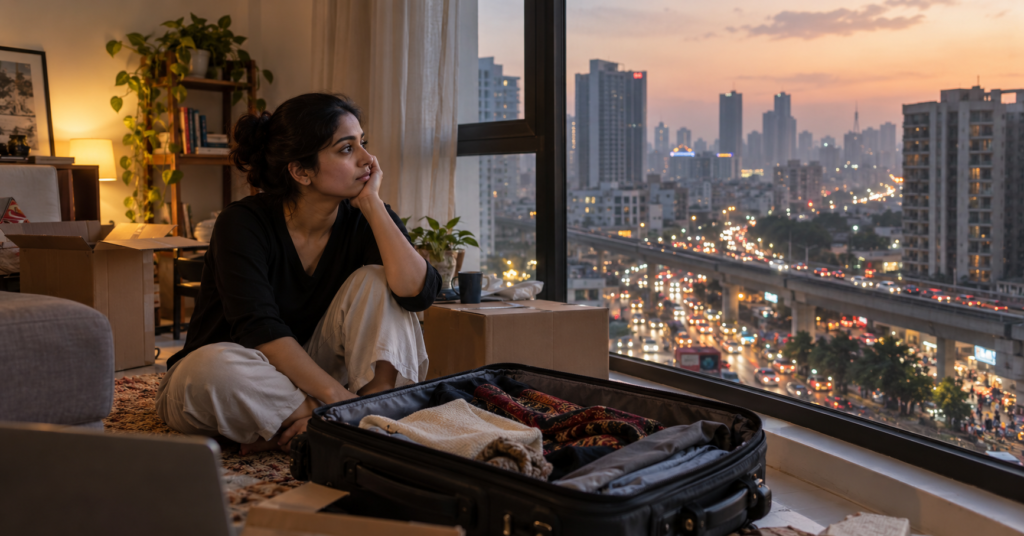
For Indians living abroad, “going home” can sit quietly in the imagination for years: parents nearby, old friends restored, familiar food, familiar language, no longer being foreign. But recent returnees are describing a more complicated homecoming. The strange part is not simply that India changed while they were away. It is discovering that they did too.
There is a particular fantasy available to Indians living abroad. It tends to appear during February rain in Amsterdam, another grey week in Berlin, a Sunday afternoon when every shop seems closed, or after hanging up a video call with parents who suddenly look older than they did last year.
I could just go home.
Home means parents within driving distance. Friends, you do not have to explain yourself to. Weddings you can actually attend. Mango season. Festivals that are not squeezed into a tiny community hall, hosting twice the number of people it can accommodate. Food that does not require a 35-minute train journey and a philosophical debate about whether €17 is an acceptable price for a dosa. The fantasy is powerful because much of it is true. But there is a complication. The India waiting for you is not necessarily the India you left. And the person returning is not the person who left, either.
The homecoming nobody tells you is another migration
In September, a Reddit user described returning to India after spending a significant amount of time in the United States. Six months into the move, the problem was not simply traffic, pollution, or bureaucracy.
It was loneliness.
Their old friends had their own lives. Attempts to make plans went nowhere. Even the relationship with their brother felt different. Meanwhile, the life they had left behind—the routine, independence, and social circle in America began to look increasingly vivid. Within days, the story appeared in Hindustan Times, NDTV, and Times of India. It was hardly an isolated sentiment.
Another returnee wrote in June that eight months after moving back, they felt they had lost part of their identity. Individually, the things they missed sounded trivial: hiking, rock climbing, watching sunsets, Mexican food, and even the clothes they used to wear. Collectively, however, those things had become their life. Someone else, after 17 years in the US, returned to India and soon posted that almost everything felt harder than expected.
A woman who recently moved from Germany to Pune after more than 15 years described relearning aspects of everyday life: punctuality, traffic, privacy, social interactions, shopping, languages, and everyday routines. Some differences were welcome; others were overwhelming. Her useful observation was that rebuilding in India required changing not simply the country, but her routines, expectations, and mindset.
Another recent poster who returned after a few years in Europe expected Indian corporate life to remain familiar because they had worked in India before leaving. Instead, meetings running over time, hierarchy, and interactions with senior colleagues suddenly bothered them much more than they remembered.
There is a name for the broader phenomenon: reverse culture shock, or more precisely, re-entry and reacculturation. And it is not new. What is new is how visibly Indians are now discussing it.
Going back to your country is not the same thing as going back to your old life.
Why coming home can be stranger than leaving
Moving abroad comes with an obvious warning label. You expect the language to be different. You expect unfamiliar bureaucracy. You expect loneliness. You Google how health insurance works. You learn which supermarket sells coriander. You accept that you will misunderstand things. Nobody expects Amsterdam to behave like Ahmedabad. Returning home has the opposite psychological setup.
You already know India. Or at least you think you do. A large 2022 longitudinal study of 1,319 people returning from time abroad examined precisely this role of expectations. The researchers found that when the experience of returning was worse than people had anticipated, larger expectation gaps were associated with poorer well-being. A 2024 systematic review of 55 studies found re-entry stress across a wide range of returnee populations and identified situational, interpersonal, intrapersonal, and contextual factors involved in readjustment. The authors also cautioned that the evidence base remains uneven and is disproportionately drawn from relatively privileged groups, particularly students and employees from the Global North.
So this is not evidence that most Indian returnees regret coming back. We do not have evidence for that claim. It tells us something more useful about human nature. Sometimes it makes adaptation harder to notice.
IN 30 SECONDS
Culture shock: “This place works differently from what I know.”
Reverse culture shock: “Why does a place I know so well suddenly feel different?”
Reacculturation: The longer process of learning how to live in your home culture again after you—and the culture—have changed.

Your friends did not spend seven years waiting for you
Friendship is where the romantic version of returning can collide particularly hard with reality. Imagine somebody leaves Bengaluru at 24. They return at 33. In their memory, there is still a group of friends who met spontaneously after work, went on late-night drives and could be summoned with a WhatsApp message containing only “beer?” Those people may still love them. They may also now have spouses, toddlers, ageing parents, mortgages, jobs requiring three days in the office and a calendar that looks like air-traffic control. Nine years passed for them too.
One June returnee made an especially useful distinction. People living abroad, they argued, can misread the intensity of the social experience of their visits to India. Friends rearrange plans because you are home for ten days. Relatives invite everyone over. Somebody is always available. Then you become a resident. The urgency disappears. As the poster put it, the special attention visitors receive changes when everyone assumes they can see you at any time. For someone returning specifically to escape loneliness, that difference can be brutal. This is one of the least discussed traps in return migration:
Holiday India is not resident India.
On holiday, you have no commute. You probably do not have an Indian manager. Your parents are delighted to see you. Friends prioritise you because you are leaving on Sunday. You eat the food you missed. Nobody asks you to renew a driving licence, deal with a landlord, find a school, sit through Monday traffic or negotiate whose parents get Diwali this year.
Then you move back. India stops being an event. It becomes Tuesday. That is the version of India a potential returnee needs to evaluate.
You may be homesick for a life that no longer exists
Sometimes what you miss is not the country, but your twenties, or the time you have spent long, long ago. The difference between reality and your version of reality is difficult to see from 6000 kilometers away. In India, someone left at 23 may contain college friends, parents who were younger, fewer responsibilities, familiar neighborhoods, and an entire social infrastructure created automatically by school, university, and family. Moving to Europe at 24 and returning at 35, you are not simply comparing two countries. You are comparing adult life abroad with the young adulthood in India of 2010’s.
This is why return migration can generate such a peculiar grief. The physical places remain recognizable enough to make you expect continuity, but the social world attached to them has moved on. Research on Indian return migration captures some of this ambiguity. A University of Edinburgh study based on interviews with 24 highly skilled professionals who returned to Bangalore found that notions of identity, home, and belonging could remain conflicted even after the move. The researcher described some returnees as inhabiting a kind of “liminal return”—caught between the desire to stay and the possibility of leaving again. That is a useful phrase for something migrants often struggle to articulate.You have returned. But emotionally, the return may not yet be complete.
Then you discover the habits you imported home
Migration changes your standards in remarkably boring ways. You become accustomed to crossing a road in a particular way. To meetings beginning approximately when the calendar says they will. To cycling somewhere without thinking about it. To nobody asking what your salary is. To doing your own grocery shopping. To being able to walk without constantly negotiating vehicles. Or, in the other direction, you become exhausted by European winters, DIY culture, empty streets after 7pm, appointments weeks away and the absence of spontaneous social life.
None of these necessarily makes one society superior.
But repetition turns cultural arrangements into normality. The Germany-to-Pune returnee described these small recalibrations precisely: moving from quiet streets to honking, from structured systems to improvisation, from stronger privacy norms to more personal questions, from self-service shopping to almost absurd levels of delivery convenience.
That is why the returnee who missed rock climbing, hiking, particular food and clothing was describing something deeper than lifestyle preference. Those activities had become part of how they understood themselves. Migration does not simply teach you how another country works. Eventually, parts of that country start operating inside you.
Work can deliver the second shock
For Indians returning from Western Europe, work deserves special attention. Again, broad claims about “Indian work culture” are useless. A startup in Bengaluru, an American multinational in Hyderabad and a traditional family-owned company in Gurgaon may share little beyond a PIN code. Recent returnee discussions themselves contain sharply conflicting accounts. One Europe returnee complained about meetings, hierarchy and treatment by senior employees after moving back. Another commenter who had worked across India, Europe, the UK, Canada and the US argued that Indian work culture was highly dependent on the particular employer and role, and that commute was a bigger quality-of-life problem for them.
After years in the Netherlands or Germany, however, certain expectations may have shifted: boundaries around evenings, hierarchy, planning, sick leave, holidays, commuting or how directly employees speak to managers. You might not notice those expectations becoming yours until somebody violates them.
The strange case of missing India while living in India
Perhaps the cruelest reverse-culture-shock moment is discovering that moving back does not necessarily cure the problem that motivated the move. Loneliness is the obvious example. A recent Indian couple in the Netherlands, after ten years abroad and now raising a two-year-old daughter, described exactly why returning can become attractive: no grandparents nearby, parents unwilling to travel frequently, and a sense that their child is growing up without the extended-family life they themselves had.
Another Europe-based Indian wrote after seven years abroad that the quality of life was good, but loneliness had slowly crept in. These are the real costs of migration. But moving back changes the variables; it does not guarantee the result. Your parents may still live in another city, and your former friends may not have as much time for you anymore. Your job may require long hours. Children may need more time to adjust. The June returnee who hoped India would solve loneliness and the lack of community eventually concluded that living there felt very different from being welcomed back as an occasional visitor.
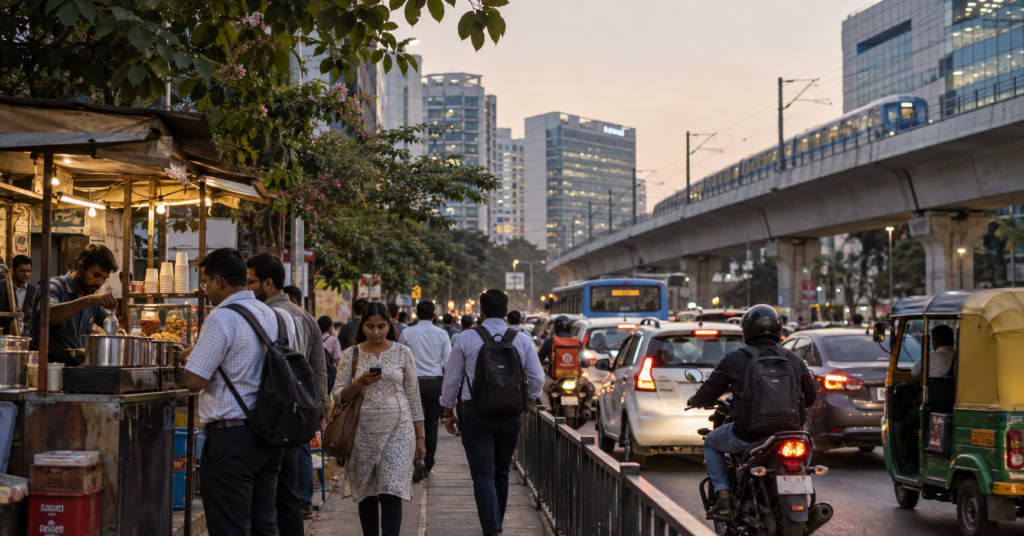
Sometimes we compare ordinary life in Europe with highlight-reel India. Then we move back and discover that India also has Mondays.
It would be easy to collect enough unhappy news articles and forum posts to construct a satisfying morality tale about regretting coming back to what you left, but the reality is way messier. Other returnees describe the opposite experience.
One person who had lived and worked in the UK, Canada, and the US told prospective returnees to expect hassle but not to treat it as a catastrophe. Their advice was unusually sensible:
“Take it as moving to a new country which happens to have your loved ones as well.”
Another recent returnee, after seven years in the US, acknowledged pollution, infrastructure problems, and bureaucracy while saying everyday reality had ultimately become less ideological than the online debate: they worked, spent time with family and friends, enjoyed convenience, and no longer had immigration uncertainty hanging over them. A German family preparing to return described the draw in almost the opposite terms: despite speaking German and having good friends, they felt they never quite acquired the sense of belonging they wanted. Time spent in India during maternity leave convinced them that returning might suit their family better.
There are also returnees who value proximity to aging parents enough that other disadvantages simply carry less weight. Others want their children to grow up around grandparents. Some see stronger career or entrepreneurial possibilities in India. Some are exhausted by immigration uncertainty. Some simply prefer Indian social life.
Those are not irrational choices. Neither is staying in Europe. The mistake is treating either choice as capable of eliminating trade-offs.
Home did move on. So did you.
There is something slightly unfair about the phrase reverse culture shock. It sounds as though something has gone wrong. Perhaps the more accurate interpretation is that adaptation abroad worked. You learned another set of rules, built routines, and became attached to the places that you once found foreign. You changed what privacy, work, independence, friendship, public space or a normal weekend meant to you.
Meanwhile, your parents aged, friends married, cities expanded, and careers diverged. India acquired UPI, ten-minute groceries, and an entirely new collection of flyovers, while somehow retaining several of the potholes you distinctly remember from childhood. Home was not preserved in amber while you were gone.
That can hurt.
But there is another way to read it. If you return, you are not required to become the person who originally left. You are allowed to bring parts of Amsterdam, Berlin, London, or wherever else you lived back with you. You are allowed to build different friendships, different routines, and a different relationship with India from the one you had at 22.
Perhaps that is the mistake hidden in the phrase “going back.” There is no back. There is only another move. And, if it works, another version of home.
Research
Geeraert et al. — Returning home: The role of expectations in re-entry adaptation (2022)