
An overseas match may sound like a relationship decision: Do I like this person? Are our families compatible? Is the salary good? But if one partner is expected to leave India, it is also a migration decision—with consequences for work, money, independence, friends, family and even the right to remain in the country.
There is a question that rarely appears on matrimonial biodata: What will your life look like at 10:30 on a random Tuesday morning, six months after the wedding?
Not during the honeymoon. Not in front of Amsterdam canals, Swiss mountains or Christmas markets. Tuesday.
Has your partner left for work while you are applying for jobs from the apartment? Are you commuting to your own office? Waiting for a residence card? Learning German? Trying to get an Indian qualification recognised? Can you work at all on your visa? Do you know anyone in the city besides your spouse’s friends?
That Tuesday may tell you more about an overseas marriage proposal than the employer name, salary package and country flag combined.
Recent discussions in Indian arranged-marriage communities have been circling around exactly this tension. In one, a woman weighing India against marriage abroad was effectively deciding between proximity to family and an entirely different future overseas. In another highly engaged thread, women considering NRI matches were urged to think harder about visas, careers and relocation rather than treating “settled abroad” as enough information. These are individual conversations, not evidence about NRI marriages as a whole—but the questions appearing repeatedly are revealing.
So rather than simply asking should you marry an NRI, ask yourself, “What exactly am I agreeing to move into?”
The NRI premium can hide the migration bill
For decades, “settled abroad” could function almost like an extra line of qualification on an arranged-marriage profile. Good company. Good salary. Europe or America. Maybe permanent residency. Perhaps already owns a house. None of these things are irrelevant. But they describe the person who is already abroad. They tell you much less about the position of the person who has to move there.
Relocation can involve several things at once:
- leaving an existing job;
- entering a completely different labour market;
- losing your professional network;
- becoming temporarily dependent on one income;
- learning a new language;
- moving away from parents and friends;
- adapting to a city you did not choose;
- dealing with housing and bureaucracy;
- rebuilding a social life;
- and sometimes holding a residence status connected to your spouse.
That does not make moving abroad a bad deal.
For some people, the move produces exactly what they wanted: more privacy as a couple, better work-life balance, independence from extended-family expectations, a different lifestyle and eventually a stronger career. The problem is treating “abroad” as the benefit, rather than examining the particular life on offer.
You are not marrying “Europe”. You are marrying one person, in one city, on one immigration status, with one financial situation.
First question: what visa will you actually have?
This should be embarrassingly specific. Ask it plainly, and clearly: “What residence permit do you have, what permit would I receive through you, and exactly what would the back of my residence card say about employment?”
The distinction matters. In the Netherlands, for example, partners of highly skilled migrants, EU Blue Card holders, certain researchers and several other categories are generally free to work. But partners of international students are not allowed to work, while partners of some other permit holders face different restrictions. If the sponsoring partner holds a temporary residence permit, the partner’s permit will also normally expire on the same date. Germany works differently again. A spouse joining a qualifying foreign skilled worker can take up employment without restriction once the residence permit is issued.
So two people can both truthfully say “I work in Europe and my wife can come as my dependent.” but those statements may produce very different lives.
WHAT TO ASK
Before committing, get the actual answers to these:
- What exact residence status does my partner have?
- What residence status would I receive?
- Can I work immediately?
- Do I need a separate work permit?
- Can I freelance or start a business?
- How long will the first permit be valid?
- Does my status depend on my spouse keeping their job?
- What happens if their employer lays them off?
- What changes once either of us gets permanent residence?
And verify the answers yourself on the immigration authority’s website.
Having the right to work is not the same as having a career
This may be the biggest distinction to understand. A spouse could have completely unrestricted work rights and still face a substantial career reset. Imagine someone earning well in Bengaluru, Hyderabad, Mumbai or Gurgaon who moves to a smaller European city. Her visa allows employment from day one. Good. Now ask the next questions.
Does her industry hire primarily in English? Is her qualification recognised? Are most relevant employers concentrated in another city? How strong is the market for her level of experience? Does the profession require the local language?
We have met numerous people who have been working as a teacher in well-established permanent job in India who have struggled finding a job in Europe for years. For regulated professions, these are not merely inconveniences. An Indian qualification may need formal recognition before someone can practise. EU guidance explicitly notes that people moving into regulated professions may need their professional qualifications recognised, and national rules apply to qualifications obtained outside the EU.
Germany, for example, requires recognition for regulated professions such as many healthcare, legal and teaching roles, while the Netherlands similarly advises holders of foreign diplomas to check whether their profession is regulated before attempting to work. If your work revolves around communicating with people, you need a very strong hold of the language – not B1 exam, but a confidence in engaging with real conversations.
A software engineer, accountant, physiotherapist, lawyer, teacher and dentist therefore should not treat “you can legally work” as the same answer.
Ask the more uncomfortable question
If I cannot find a job comparable to my current one for 12 months, are we both genuinely okay with that?
Not theoretically.
Financially and emotionally.
Would your partner still see the move as something the two of you chose together? Or would unemployment quietly become “your problem”?
That distinction matters.
“Of course I support your career” needs a stress test
Almost everyone can support a hypothetical career. The useful questions involve trade-offs. Suppose you move to Germany for your spouse and receive an excellent job offer in another German city.
Would you move?
Suppose your best opportunity requires six months of language training. Is that already part of the plan and budget?
Suppose you are earning more three years later and receive an opportunity in another country. Does your career suddenly become the one the household relocates for?
Suppose you both work full-time. Who cooks? Who cleans? Who handles appointments, paperwork and eventually childcare?
Suppose you cannot work for eight months. Do you still have money of your own?
These conversations reveal much more than asking: “Will you support my career after marriage?”
Of course the socially correct answer to that question is yes. Ask for the operating model.
Salary is not a household balance sheet
An overseas salary looks especially impressive when converted into rupees.
€90,000 becomes a large number very quickly.
That still does not tell you the take home pay, rent or mortagage, debts, loans, insurances, and financial support you might send to parents. This is not uniquely an NRI issue. Anyone marrying should understand their partner’s finances. But relocation raises the stakes because one partner may be giving up income and arriving without their own financial history, local network or immediate earning capacity. So do not ask only: “How much do you make?” Ask: “What does our household balance sheet look like after I move?”
QUICK FINANCIAL CHECK
Before relocation, both people should know roughly:
Income
- monthly household take-home pay;
- bonus reliability;
- whether employment is permanent or temporary.
Fixed commitments
- rent or mortgage;
- loans;
- family remittances;
- insurance;
- transport;
- existing dependants.
Savings
- emergency fund;
- investments;
- how many months the household could survive on one income.
Your transition
- moving costs;
- flights;
- language courses;
- qualification recognition;
- further education if required;
- expected period without income.
If discussing these numbers feels inappropriate before marriage, becoming financially dependent after marriage will not make the conversation easier.
Visit the life, not just the person
One of the simplest suggestions appearing repeatedly in overseas-match discussions is also one of the most useful. Visit before committing, if reasonably possible. But do not turn it into a five-day European holiday. Try the commute. See the apartment. Walk through the neighbourhood at 8pm. Go to the supermarket. Look at the nearest train or bus connection. Spend some time while your prospective spouse is at work. Meet their friends.
See whether the city actually contains jobs relevant to you.
If they live outside Amsterdam, Munich, Frankfurt or another employment centre because the rent is cheaper, calculate what that means for your commute.
The purpose is not to decide whether Europe is pleasant. Europe is excellent at being pleasant for seven days. You are trying to understand whether your ordinary life there works.
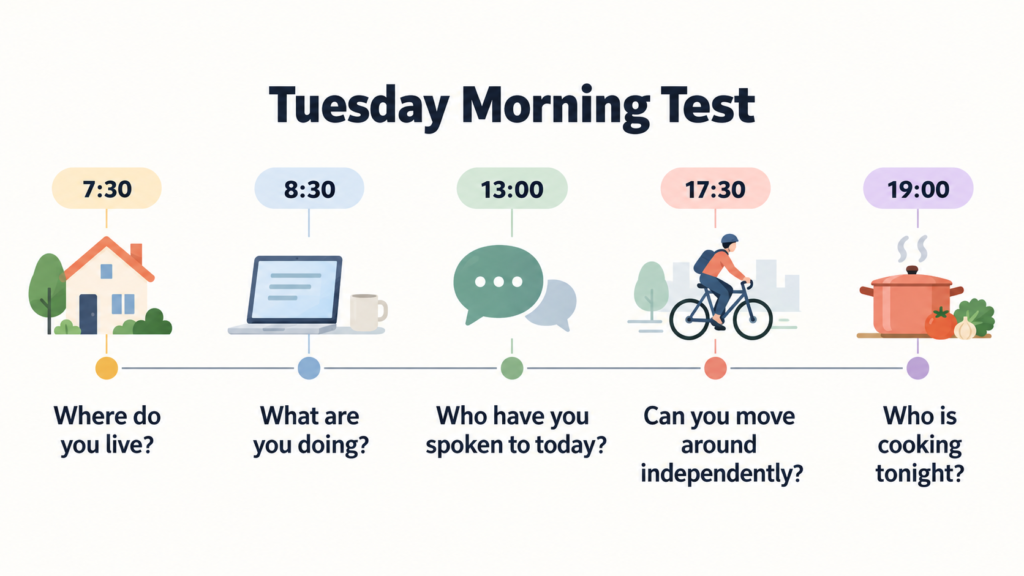
Do the Tuesday Morning Test
Forget the wedding for ten minutes. Imagine that you have already been married for six months. It is Tuesday.
7:30am
Where do you live? Is this a city you would have chosen yourself?
8:30am
Your spouse starts work. What are you doing? Going to your own job? Studying? Applying? At home with a child? Waiting for paperwork?
1pm
Who have you spoken to today? Colleagues? Friends? Nobody except your spouse on WhatsApp?
5:30pm
Can you move around independently? Do you drive? Cycle? Take public transport? Does everything require your partner?
7pm
Both of you are tired. Who is cooking?
Friday
What do you do socially if your spouse already has an established circle and you do not?
Three months later
Your parent in India becomes ill. How expensive are flights? How much leave do you have? How often could you realistically go home? That is the actual migration decision hiding inside the marriage decision.
Ask yourself – could you imagine living this particular life abroad?
The social reset is real too
There is a structural imbalance when one person relocates into the other’s established life. The existing migrant may already have their friends, colleagues, favourite restaurants, doctors, routines, knowledge of the language. You arrive with none of them. Both couples should recognize the asymmetry ahead of pretending that both partners are beginning their married life from the same starting point. If almost every local connection initially runs through one person, building an independent life needs to be deliberate.
Ask yourself. Can I meet people independently? Is there a community relevant to me? Can I take classes or pursue hobbies? Is my partner comfortable with me developing my own social life? What happens when loneliness hits after the novelty of moving wears off?
People frequently research salaries and visas before migration. They rarely spreadsheet loneliness. It can still shape whether the move succeeds.
The pre-NRI-marriage checklist
Before saying yes, you should be able to answer most of these without guessing.
Visa and immigration
- What exact visa or residence permit does my prospective spouse have?
- What permit would I receive?
- Can I legally work immediately?
- Is my residence dependent on my spouse?
- How long before I could obtain an independent or permanent status?
- What happens to my residence if my spouse loses their job?
- What happens if we separate?
Career
- Is my profession realistically portable to this country?
- Is my qualification recognised?
- Do I need the local language?
- What do people with my experience actually earn there?
- Which cities contain jobs in my field?
- Am I prepared for a lower title or salary initially?
- What happens if I am unemployed for 6–12 months?
- Would my partner relocate for my career later?
Money
- What is our actual combined take-home income?
- What debts do both of us have?
- How much has my partner genuinely saved?
- What financial obligations exist toward parents or others?
- Can we comfortably live on one income?
- Will I have access to money independently while I am not working?
Daily life
- Where exactly will we live?
- Can I commute independently?
- How isolated is the location?
- Who does the household work?
- What social network will I have outside the marriage?
- What does a normal weekend look like?
India
- How often can we realistically visit?
- Who pays for those trips?
- What happens when parents become older or ill?
- Is returning to India eventually part of the plan—or something both people merely say because the future feels far away?
Relationship
- Whose career takes priority when the two conflict?
- How are major financial decisions made?
- What expectations exist around children?
- What role will either set of parents have?
- What sacrifices is the person already abroad willing to make?
That last question deserves particular attention. Relocation should not mean that one person makes every structural sacrifice simply because the other happened to migrate first.
An overseas match can still be an excellent match
None of this is an argument against marrying someone abroad. It is an argument against evaluating an overseas match using information that describes only the groom or bride who already lives there. Country, salary, permanent residency and employer are useful facts. They are not a life plan. A person in India considering an NRI match should be evaluating two things simultaneously.
First, Do I want to build a life with this person?
And, Would I choose enough of the life that comes with them?
You do not need to love every part of the answer. But before saying yes, you should at least know what Tuesday morning looks like.