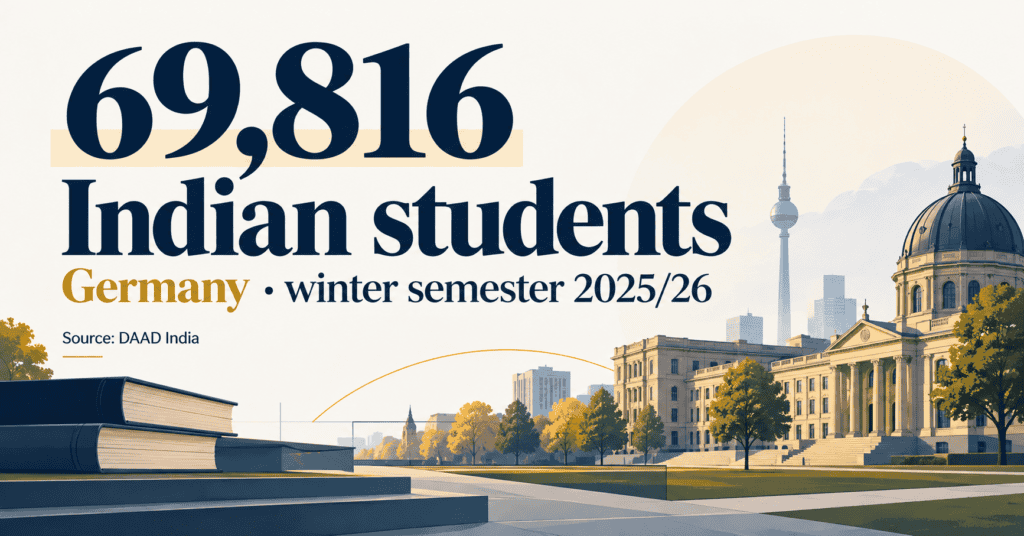
India has become a major source of students for German universities. That creates a large potential peer community, but it does not make every programme, city, or career path equally suitable. But what is the reality in these university cities?
Nearly 70,000 is the sort of number that makes a study destination feel established. Someone researching a German master’s program can reasonably expect that other Indians have taken a similar route. Parents may hear it as reassurance. University towns may experience it through student associations, friendships, shops, and events.
Three figures, one reference period
In its public update for the winter semester 2025/26, DAAD India reports the following:
| Figure | What DAAD India reports | What does it mean |
|---|---|---|
| 69,816 | Indian students enrolled at German universities | The size of the enrolled population for that semester |
| 17.5% | Year-on-year growth in Indian enrolment | The reported change in that population is not a success rate |
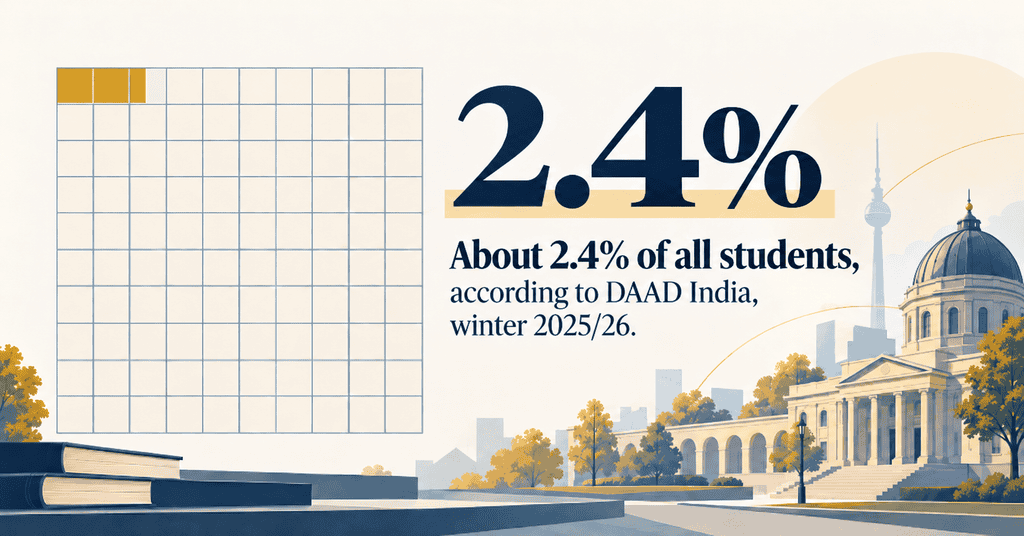
| 2.4% | Indian students as a share of Germany’s total student population | A sizeable cohort within the wider university system |
DAAD India identifies Indians as the largest international student group in that update. The figures refer to a defined semester; they should not be presented as a live count of everyone studying in Germany today.
Enrolled is not the same as newly arrived
Imagine a student who stays for several semesters. They can appear in successive enrolment totals without having arrived again. Another person can enter a program and later leave it. A national enrolment count is a snapshot of a population, not a complete account of individual journeys.
| Question | Can the enrolment total answer it? |
|---|---|
| How large is the Indian student population in the stated semester? | Yes, within the source’s definition |
| How many Indians arrived in Germany that year? | No |
| How many completed their degree? | No |
| How many found a job after graduating? | No |
| Will my particular course suit me? | No |
The distinctions can sound technical until you are making a decision. A growing population may offer more potential connections. It cannot tell you whether your modules, language needs, housing options, or professional plans are a good match.
Why do different “international student” totals appear
German statistics distinguish between foreign citizenship and international educational mobility. Wissenschaft Weltoffen’s methodology classifies categories by citizenship and by where a student obtained their university entrance qualification. A foreign citizen educated in Germany can be counted differently from someone who moved there for higher education.
That helps explain why you should check definitions before combining reports. A DAAD release about winter 2024/25 refers to around 402,000 internationally mobile students. The period and population must match before such a number is compared with another headline total.
For this article, the Indian count and reported growth remain explicitly attributed to DAAD India. Different international-student totals have not been stitched into a trend chart.
The next question should get smaller
The national scale is a useful background. Your next questions should be about the program and city you are actually considering:
- What will I study, beyond the course title?
- What language does the program require, and what language will I need outside it?
- Can I speak to current students from the same course?
- What does finding accommodation involve in this city?
- What evidence does the program provide about graduate destinations?
Ask a current student for concrete details: a normal week, an unexpected cost, or something they wish they had checked. Those answers do a different job from the national statistics.
Almost 70,000 enrolments make Germany’s Indian student story substantial. Your own story will still be shaped at the level of a course, a room, a timetable, and the decisions you make inside them.
Sources
- DAAD India. Public winter semester 2025/26 update. Figures attributed to the issuing organization; checked 13 October 2026.
- DAAD / DZHW. Wissenschaft weltoffen 2025, methodology and glossary.
- DAAD. Wissenschaft Weltoffen 2025 press release, 26 November 2025, covering the winter 2024/25 period.