
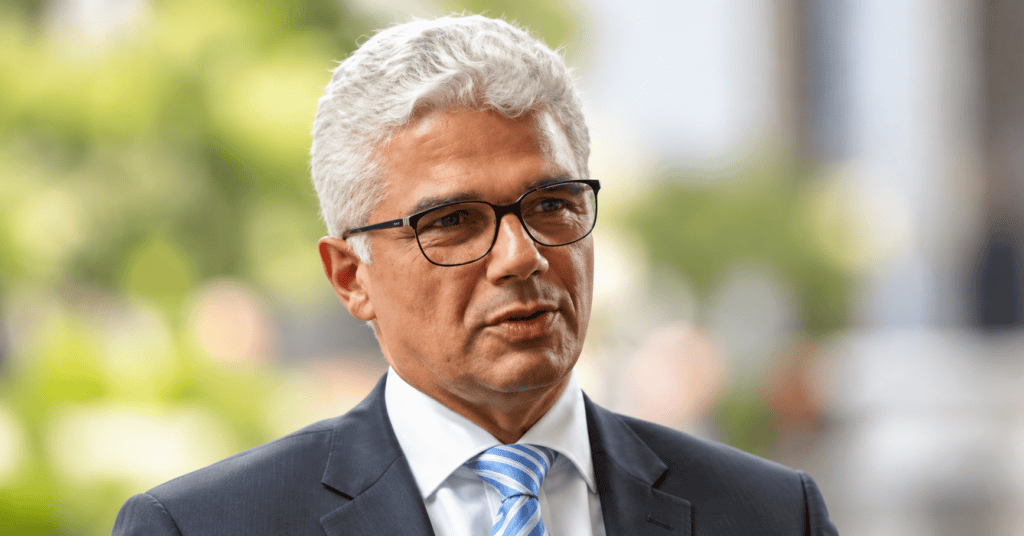
An Indian father, a German mother, childhood trips to India, and a family history in Bonn going back centuries. Ashok-Alexander Sridharan’s story has all the ingredients of a fascinating cross-cultural biography. But the man himself has always been rather clear about where he belongs.
A little bit of India, a lot of Bonn
Imagine having a name that immediately makes people curious about your origins, an Indian father, a German mother, and a family history stretching back hundreds of years in one German city.
Now imagine becoming the mayor of that very city.
Meet Ashok-Alexander Sridharan, the silver-haired, bespectacled politician who made headlines in 2015 when he became the first mayor of Bonn with an immigrant family background.
In India, his victory attracted attention for the obvious reason: the connection to his father’s homeland. In Germany, the story had another twist. Here was a politician with Indian roots who was also, quite unmistakably, a Bonner Jung—a local boy from Bonn.
And he was perfectly comfortable with that description.
In a 2019 interview with Deutschlandfunk Kultur, he made a remark that neatly captures his outlook:
“I never felt like a migrant.” Translated from German; Deutschlandfunk Kultur, August 2019.
For Sridharan, growing up with two cultures was less about choosing between them and more about simply being himself.
A diplomat father, a German mother, and roots going back to 1590
Sridharan was born in Bonn in 1965. His father was an Indian diplomat who had come to West Germany in the 1950s, when Bonn was still the country’s provisional capital. His mother was German, from a family with remarkably deep roots in the city.
How deep? According to his 2019 radio profile, her family’s connection to Bonn dates back to 1590.
That’s more than four centuries of family history. Plenty of people might call themselves local after living somewhere for twenty years. The Sridharan family, on his mother’s side, could trace ancestors who had lived in Bonn long before modern Germany even existed.
Yet there was another world in his childhood, too.
He grew up bilingual, and family trips to India were a regular part of his early life. In that same interview, he remembered his upbringing between two cultures positively.
There was also an interesting religious dimension to the household. His father, who came from a Hindu Brahmin family, married his German mother in a Catholic church. Sridharan himself became a practicing Catholic, later speaking about the importance of both faith and religious tolerance in his life.
It was a childhood shaped by several traditions, without any apparent need to turn them into competing identities.
Before the mayor’s office came years of municipal paperwork
Sridharan’s route into politics was considerably less glamorous than the international headlines might suggest.
He went to school in Bonn, studied law at the University of Bonn, and built a career in local government. Before entering the city’s top office, he worked in the neighboring town of Königswinter, where his responsibilities included finance, administration, personnel, and other municipal affairs. In other words, he knew the sort of things that actually keep a German town running: budgets, staffing, public services, and administrative decisions.
Not exactly the material of a dramatic political biopic. But rather a useful experience for someone hoping to become mayor.
Then came 2015.
Running as a candidate for the center-right Christian Democratic Union (CDU), Sridharan won Bonn’s mayoral election with just over 50% of the vote. His victory ended 21 years of Social Democratic leadership in the city.
There were two stories here. One was political: a significant change in Bonn’s leadership. The other was personal: a German politician with an Indian father was about to lead one of the country’s most internationally recognized cities.
His campaign, however, had emphasized something far more familiar to local voters. He was a Bonn man, standing for office in his own hometown.
As Deutsche Welle reported at the time, he did not consider his Indian ancestry the defining issue of the campaign.
The mayor who liked walking by the Rhine

The Rhine and the nearby Siebengebirge hills are among Bonn’s characteristic landscapes.
Public office can make a person seem rather distant. Fortunately, Sridharan left behind a few clues about the ordinary things he enjoyed.
In a delightful little 2016 interview for deutschland.de, he answered questions about his favorite places, holidays, and what he loved about Bonn.
His preferred spot in the city? The banks of the Rhine, where he enjoyed family walks and, when time permitted, a little jogging.
His favorite holiday destination wasn’t particularly exotic either. It was Lake Constance, where he and his family had been going for years.
He also had a soft spot for Bonn’s famous son, Beethoven, and took pride in the city’s international atmosphere, its United Nations presence, and the friendly character he associated with the Rhineland.
There is something endearing about a politician whose answers to a city lifestyle questionnaire involve riverside walks, familiar family holidays, and showing visitors a peaceful old church cloister. One gets the impression of a man who genuinely liked the city he was elected to run.
The phone call that came during a pilgrimage
One of the more unusual details of Sridharan’s political story concerns the moment he was asked to run for mayor.
He was on a pilgrimage when his party called to ask whether he would consider standing for the position.
It’s a rather unexpected setting for a conversation about municipal elections, campaign strategy, and the future of a German city. But it also says something about the place religion occupied in his life.
Sridharan discussed the episode in his 2019 Deutschlandfunk Kultur interview, as well as his family’s different religious traditions.
The politician who grew up visiting India, attended a Catholic church, and worked his way through the local government in Germany was now being invited to lead his hometown. Life had brought together some rather unlikely ingredients.
A public life that wasn’t always so comfortable
Of course, being mayor involved more than ribbon-cuttings and pleasant walks by the Rhine. Sridharan’s time in office was marked by serious questions about refugee integration, climate policy, and Bonn’s relationship with Berlin.
He took a particular interest in sustainability, serving as president of ICLEI, an international network of local governments working on environmental issues. He also argued for reducing government-related flights between Bonn and Berlin and improving rail connections.
His views on immigration combined an emphasis on integration with an insistence that newcomers follow Germany’s rules. His positions were those of a working CDU politician, not simply a representative of multicultural Germany.
And there were unpleasant parts of public life. In 2019, he spoke about threats directed at him and other local politicians, including incidents involving people appearing outside his home. Despite concerns for his family’s security, he believed a mayor needed to remain approachable. It is a reminder that occupying public office, even in a picturesque city like Bonn, can bring pressures that rarely appear in celebratory stories about political success.
Sridharan served as Bonn’s mayor from 2015 to 2020. He was succeeded by Katja Dörner, and the city’s current mayor, Guido Déus, took office in November 2025.
So, Indian or German? Perhaps that’s the wrong question.
People are often curious about where someone is really from. A surname becomes a conversation starter. Family history becomes an explanation. An achievement becomes an occasion to celebrate a connection to a particular country.
And sometimes that connection is genuinely meaningful.
Sridharan has never hidden his Indian heritage. Childhood visits to India, his father’s background and his experiences of growing up in a bicultural household are all parts of his story.
But he has also never seemed particularly interested in treating his ancestry as his entire identity.
He was born in Bonn, grew up there, studied there, worked in the surrounding region, and eventually became Bonn’s mayor.
His story is not about a man who traveled from India to Germany and made it big. It is about a German man with Indian roots who built a life in the place his family had called home for generations.
And perhaps the nicest detail is the simplest one.
After all the election headlines, international attention, and discussions about identity, ask Sridharan where he liked to spend his free time, and his answer was wonderfully ordinary: walking along the Rhine with his family.
Sometimes, belonging is as uncomplicated as knowing exactly where you want to go for a Sunday stroll.
Sources
This retrospective profile draws on published interviews and reporting, not a new interview conducted by AlmostLocal.
- Deutschlandfunk Kultur — Interview with Ashok-Alexander Sridharan, 28 August 2019
- Deutsche Welle — Bonn’s first Indian mayor, 14 September 2015
- deutschland.de — Bonn: Open and International, 19 January 2016
- German United Nations Association — Interview with Sridharan about Bonn
- City of Bonn — Official mayoral election information