
Long before today's Indian professionals built communities in Amstelveen and Eindhoven, descendants of Indians who traveled through Suriname were celebrating Divali in the Netherlands. Now two very different diaspora histories are meeting around the same festival.
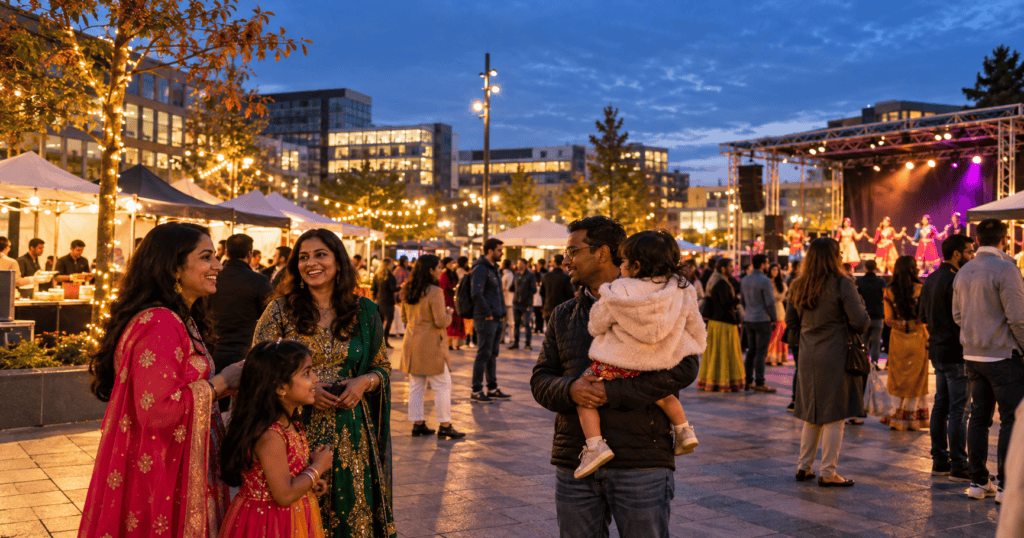
On 31 October, Amstelveen’s Stadsplein will fill with Indian food stalls, Bollywood performances, music and families for the 18th Diwali Festival. The festival began in 2009 as a collaboration involving the growing Indian community around Amsterdam and Amstelveen. Today more than 5,000 Indian citizens live in Amstelveen alone. [Visit Amstelveen]
Around the same period, another community will be celebrating Divali. A Hindu primary school in The Hague has a Divali celebration and torch procession scheduled for 6 November. Laaktheater has a Divali programme combining live music, classical Indian dance and Bollywood. Last year’s celebration transformed Paul Krugerplein into a public Divali space. Algemene Hindoe Basisschool
Though it feels like the Indian expat community is spread around the two festivals, how these two arrived in the Netherlands could hardly be more different.
Two journeys from India to the Netherlands
The immigration from India to the Netherlands accelerated dramatically after 2005. Before then, only around 600–1,000 people migrated from India to the Netherlands annually. Immigration subsequently surged, reaching almost 15,000 in 2022. By 2024, approximately 89,000 residents of the Netherlands had India as their country of origin. Work, particularly knowledge work, and family migration account for most arrivals. [Centraal Bureau voor de Statistiek]
However, long, long ago, when the British were ruling India, more than 35,000 people from British India arrived in Suriname under the indentured-labor system established after slavery between 1873 and 1916. Many came from areas that are now Uttar Pradesh and Bihar. Roughly a third eventually returned; the rest helped create what became the Hindostani-Surinamese community [Nationaal Archief]. Large numbers of Surinamese moved to the Netherlands around Suriname’s independence in 1975. CBS records particularly heavy Surinamese migration between 1972 and 1981. [Centraal Bureau voor de Statistiek] So an Indian engineer arriving at Schiphol in 2026 and a Dutch Hindostani whose grandparents arrived from Suriname in 1975 may share ancestral geography, but one family’s last experience of India was last summer. The other’s may have been five or six generations ago.
And yet, both light the diyas
The Hindostani community didn’t simply preserve an Indian culture unchanged for 150 years. It created its own culture through India, Suriname, the Caribbean and eventually the Netherlands. Even the language tells that story.
Sarnami developed from the languages brought by indentured workers, particularly Bhojpuri-related varieties, but changed through contact with other languages in Suriname. It eventually became recognized as a language in its own right. The same happened to music and dance. A 2026 study of Dutch Surinamese-Hindostani dance describes traditions that combine nineteenth-century Indian roots with Bollywood aesthetics, Caribbean rhythms, and Dutch influences [Taylor & Francis Online]. Divali traveled too. Surinamese Hindostani families carried the festival from India to Suriname and subsequently to the Netherlands. In Suriname, Divali has become sufficiently embedded in national culture that it has been a national holiday since 2010. [Wereldmuseum Rotterdam]
One account of a family’s Divali in rural Suriname remembers a boat arriving before the festival carrying handmade diyas. Families without enough money could apparently pay for them with rice. The grandfather would put a lit diya on a small board and send it onto the Saramacca River; the next evening, the house and yard would be illuminated. Put that beside today’s Amstelveen Stadsplein. Same little lamp, extraordinary journey.
Amstelveen provides the perfect physical manifestation of the newer diaspora. Its Indian population grew from fewer than 1,600 in 2012 to more than 4,800 by 2019. Today, local sources put the number of Indian citizens above 5,000. International schools, technology and financial-sector employment and proximity to Schiphol helped create what has sometimes been called a Dutch “Little India.” [Springer] And in 2009, this newer community helped establish the public Diwali Festival on Amstelveen’s Stadsplein [AmstelveenWeb].
“Wait, they’re Indian?”
Many Indians are not aware of Suriname, or any part of migrations in the past century, and only realize the extent of the culture only after arriving in the Netherlands. In a 2025 discussion started by a Dutch-born Surinamese Hindu, an Indian expat wrote that he was initially surprised to encounter people in the Netherlands who looked Indian but spoke Dutch. Only later did he learn about their Surinamese history. Another commenter said they had known essentially nothing about Suriname before moving here. [Reddit] But the conversation gets more interesting from the other direction.
The original poster described himself as culturally partly Indian but also South American and European. Other Hindostani voices resist simply being classified as Indian. A 2024 community discussion asking about the interaction between Indians and Indo-Surinamese people produced the strikingly mundane answer that the communities often don’t interact very much at all. Reddit
And just three days ago, someone identifying as sixth-generation Surinamese posted about having ancestors from Bihar while admitting that their generation no longer speaks Sarnami particularly well. [Reddit]
How much shared ancestry does it take to make two communities feel related? Diwali makes the overlap visible, but it doesn’t erase 150 years of different history. A newcomer might notice Diwali on an Amstelveen poster and Divali on a program in The Hague. Are these two different festivals, or two slightly different forms of one? Let us know what you think.