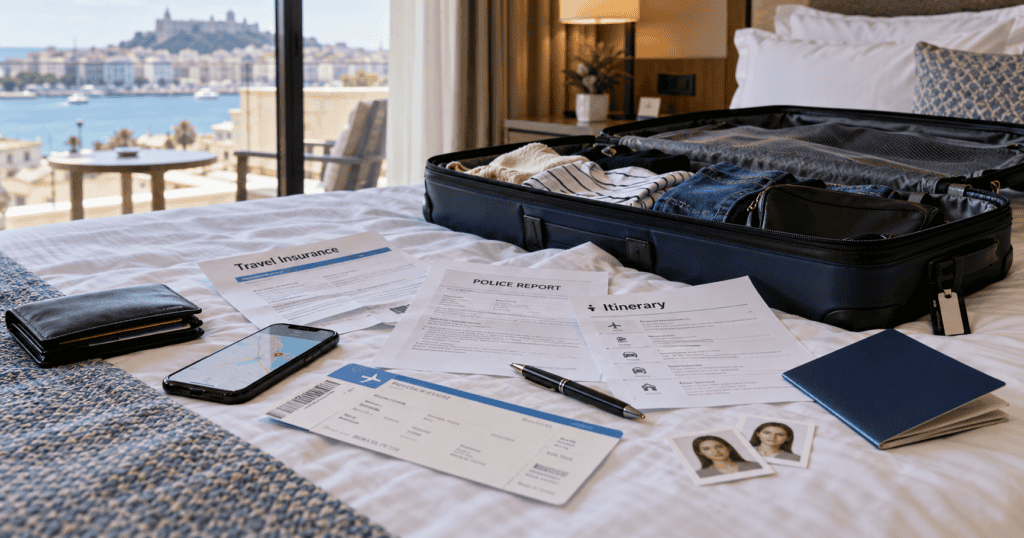
Losing your passport abroad feels catastrophic for about ten minutes. Then it becomes a bureaucratic problem; and usually a solvable one. This guide explains the police report, Indian Embassy, Emergency Certificate, replacement passport, visas, Schengen travel and the especially confusing case where you live in one country but lose your passport while visiting another.
You are walking down the shopping street near the beach in Malaga, and you are ready to head to the beach. You visit a souvenir shop to buy a cute fridge magnet showing a señorita dancing in a red flamenco outfit with polka dots, and you are already imagining how it will look next to the other twenty magnets you have at home. You open your bug to get the money – and find it already open. Maybe some money is gone. You explore everything inside. The passports. Oh, the passports are gone.
You ask your fellow travelers. You check the same pocket again. Then the other pocket. Every compartment in your bag, including the one you know you haven’t opened all week. The two Euro flamenco lady is still waiting – and you can’t think about her anymore. And then the questions arrive together.
Can I still fly? Am I legally allowed to stay here? What happens to my visa? Can I cross into another Schengen country? Do I need to go back to India? What if I actually live in the Netherlands or Germany? My flight is tomorrow. Am I completely screwed?
First: this is serious, but it is fixable.
First, this happens regularly. Local police, embassies, airlines regularly deal with such situations.
You are not stateless, not did your visit to this country immediately became illegal.
What you have lost is an extremely important identity and travel document, and possibly the visa contained inside it.
Indian embassies and consulates regularly deal with lost passports. Losing the physical booklet does not make you stateless, cancel your Indian citizenship, or automatically erase your residence status in another country. What you have lost is an extremely important identity and travel document—and possibly the visa contained inside it.
If you ar ereading this article right after you realized you have lost your passport, the only sane thing to do is read further and become aware of the simple next steps you have to follow.
The solution depends mainly on two questions:
Where are you now?
and
Where do you need to go next?
But before working that out, do the following.
START HERE: I just realized my passport is missing
1. Search once, properly
If you merely cannot find the passport and have no reason to believe it was stolen, spend a short, focused period retracing your steps. Check your bag again, jacket and trouser pockets, the hotel safe, reception, the last restaurant or café, taxi or ride-share lost property, train or bus operator. Don’t spend half a day hoping it reappears. But don’t begin replacing a passport that is sitting behind your laptop either. The first step is to ascertain that it is indeed lost. Then move to the next step.
2. Report it to the local police
A passport lost abroad should be reported to the local police and to the relevant Indian Mission/Post. Get written evidence in the form of a police report, complaint number, loss report, or whatever equivalent the local police system provides. Do not become hung up on the word FIR. Many countries do not use that terminology, and some police forces handle lost property differently from theft. What matters is following the local procedure and obtaining evidence of your report wherever possible.
In many police stations, the officer at the first point of contact will ask you to make an appointment, and you will have to explain that it is an emergency. Don’t shy away from using Google Translate when you realize there is a margin of communication error. They will ask you questions about what you know and what you don’t know in order to enter as many details in the report as possible. If possible, ask them to find a translator or provide a translated copy of the report. The process will take 1-2 hours. Your goal is not to initiate an investigation, but to obtain an honest account of the details so you can move to step three.

3. Contact the Indian Embassy or Consulate responsible for where you are
Look at the official website of the Indian mission serving your current location. For a lost passport emergency, some missions provide emergency numbers or walk-in arrangements. Others route passport applications through a service provider like VFS or BLS. Requirements vary, so do not rely on a checklist from another country as if it automatically applies where you are.
If it is not possible to connect with someone by phone, just head to the nearest VFS or Embassy after you have completed step four.
4. Gather every copy of your documents
Find whatever you have of:
- lost passport;
- passport number;
- issue and expiry dates;
- visa;
- residence permit;
- Aadhaar, PAN, driving license, or other Indian identification;
- travel tickets;
- proof of address;
- passport photographs.
- police report you obtained from Step 2
No passport copy? Don’t assume you are stuck. Indian mission guidance says copies are useful, but in some cases, previous passport details and other proof of Indian identity can be used to establish your particulars. Keep multiple copies handy.
5. Do not assume you can simply continue traveling
A police report is not a new passport. A residence card is not a passport. A photograph of your passport is not a travel document.
The next few plans in your itinerary will surely change because you will spend almost half a day at the embassy and still be figuring out what to do next. You may need to visit a couple of other offices depending on your situation. Next, you will visit the VFS or the Embassy and we will discuss more about what happens next. First, take a breath.
Take a breath: people do get home from this
Before the bureaucracy, three real situations are worth reading. Not because Reddit determines immigration law, but because these stories show how different the outcomes can be.
Story 1: Their passports were stolen on day one in Rome
An Indian couple traveling through Europe with their elderly parents had both passports stolen from a backpack on a crowded bus in Rome. It happened on the first day. Their itinerary still included Italy and Switzerland, and their eventual flight back to India departed from Zurich.
They contacted the Indian Embassy, reported the theft to the police, and spent the following days piecing together what they could legally and practically do. Eventually, they received Emergency Certificates in Switzerland and successfully returned to India. Afterward, one of them wrote a detailed Reddit post because they had found only “limited information for our exact use case.”
They did travel overland from Italy to Switzerland without encountering a border check. That part of their story should not be interpreted as proof that everyone can legally do the same. Even the author explicitly acknowledged the uncertainty. The useful lesson is simpler: A stolen passport can seriously disrupt a trip without leaving you permanently stranded.
Story 2: An NRI lost his passport in Spain—and “going home” became complicated
Another Reddit post describes a much harder case second-hand.
An Indian citizen had grown up outside India, later lived in the UK, and lost his passport while visiting Spain. According to the account, he obtained an Emergency Certificate and traveled to India. The problem? India was his country of citizenship, but it was no longer where his life was based.
Once there, the writer says he faced difficulties obtaining another passport because he lacked straightforward Indian address documentation and had lived abroad for decades. The process reportedly took one or two months before he could return to the UK. This is an anecdote, not an official account, and procedures vary considerably. But it reveals perhaps the most important thing an NRI should understand: “Returning to India” and “returning home” may be two different objectives.
If you live in Amsterdam, Berlin, or Brussels and lose your passport while visiting Barcelona, tell the Indian mission that immediately. An Emergency Certificate may not be the best fit for your situation.
Story 3: A student’s passport was not actually lost
In May 2026, a 23-year-old Indian student flew from Edinburgh to London on his way back to India. After landing, he realized that his passport and boarding passes were missing. His next flight was only hours away. He contacted airport staff while simultaneously asking online what emergency document he might need.
Then the cleaners found the passport on the aircraft. He made his flight. There is a useful lesson buried in that wonderfully uneventful ending: Before activating the full lost-passport machinery, make sure the passport is actually lost.
Once you formally report a passport to Indian authorities and begin replacement procedures, do not assume you can simply resume using it if it later appears. If that happens, contact the relevant Indian mission and confirm its status before traveling.
What have you actually lost?
It helps to separate four things that panic tends to merge together:
Your citizenship: You are still an Indian citizen.
Your passport: The physical travel and identity document issued by India is missing.
Your visa: If a visa sticker was inside that passport, that physical visa document has also disappeared.
Your residence status: If you legally live in another country, losing your passport does not by itself mean your underlying residence status has vanished. But you may need specific documents to prove that status and to travel.
EU guidance treats these as distinct documents: passports, residence permits and visas can each be used for travel, identity or evidence of a right to stay.
You did not suddenly become an illegal visitor. Your problem now is – (i) can I continue my planned journey legally? and (ii) What document do I need now?
The most important question: where do you need to go?
This determines which Indian document you should discuss with the mission.
Situation 1: You are a tourist and want to return to India
This is the classic Emergency Certificate scenario. The Indian Embassy in the Netherlands describes an Emergency Certificate as a “one-way travel document” for return to India. Spain is even more explicit. The Indian mission says an Indian tourist who loses a passport and wants to return directly to India may obtain an EC, a “one-time travel document valid for only one journey to a destination in India.”
You will generally need some combination of:
- online EC application;
- police report;
- copy/details of the lost passport;
- photographs;
- explanation of how it was lost;
- flight reservation;
- evidence allowing the mission to verify your Indian nationality.
Exact requirements vary.
The goal of an EC is simple: Getting an Indian citizen back to India. If you get an EC, you can safely go back to India.
Situation 2: You live abroad and need to return to your country of residence
This is where many online guides become too simplistic.
Imagine:
- you are an Indian citizen;
- you live legally in the Netherlands;
- you have a Dutch residence permit;
- you travel to France;
- your Indian passport is stolen.
You do not necessarily want a document whose purpose is to send you to India.
France’s Indian Embassy explicitly recognizes this distinction. Its current guidance states that an Indian national residing in a country other than India may be issued a Short Validity Passport rather than an EC. Applicants are asked for, among other things, a police report and a residence card from the country where they live. Spain makes a similar distinction: a tourist seeking to return directly to India may apply for an EC, while someone wishing to travel to a country other than India is directed to a replacement passport.
So tell the consular officer clearly:
“I am an Indian citizen, but I am legally resident in [country] and need to return there.”
This will take a bit longer, and you may need to extend your trip to obtain your passport.
Situation 3: You lost your passport in the country where you live
If you live in the Netherlands and lose your passport there, you are generally looking at reissuing the passport, rather than following the same procedure as a visiting tourist. The Indian Embassy in The Hague explicitly separates the two: tourists who have lost their passports are directed to the EC process, whereas NRIs residing in the Netherlands are directed to passport reissue. Belgium similarly lists loss or damage of the current passport as a reason to apply for passport reissue. This is why searching only for “emergency Indian passport” can send you down the wrong path.
Emergency Certificate or replacement passport?
| Emergency Certificate | Replacement / short-validity passport | |
|---|---|---|
| Main purpose | Return to India | Restore a passport for broader travel |
| Normal destination | India | Depends on your circumstances |
| Useful for continuing a European holiday? | Generally no | Potentially, once other visa/entry issues are resolved |
| Appropriate for an NRI returning to Europe? | Often not the ideal route | Ask the mission about replacement/SVP |
| Requires identity/nationality verification? | Yes | Yes |
| Does it restore a lost visa? | No | No |
The Netherlands mission is unusually blunt when asked whether an EC can be used to visit a third country or travel within Europe/Schengen: “Strictly No.”
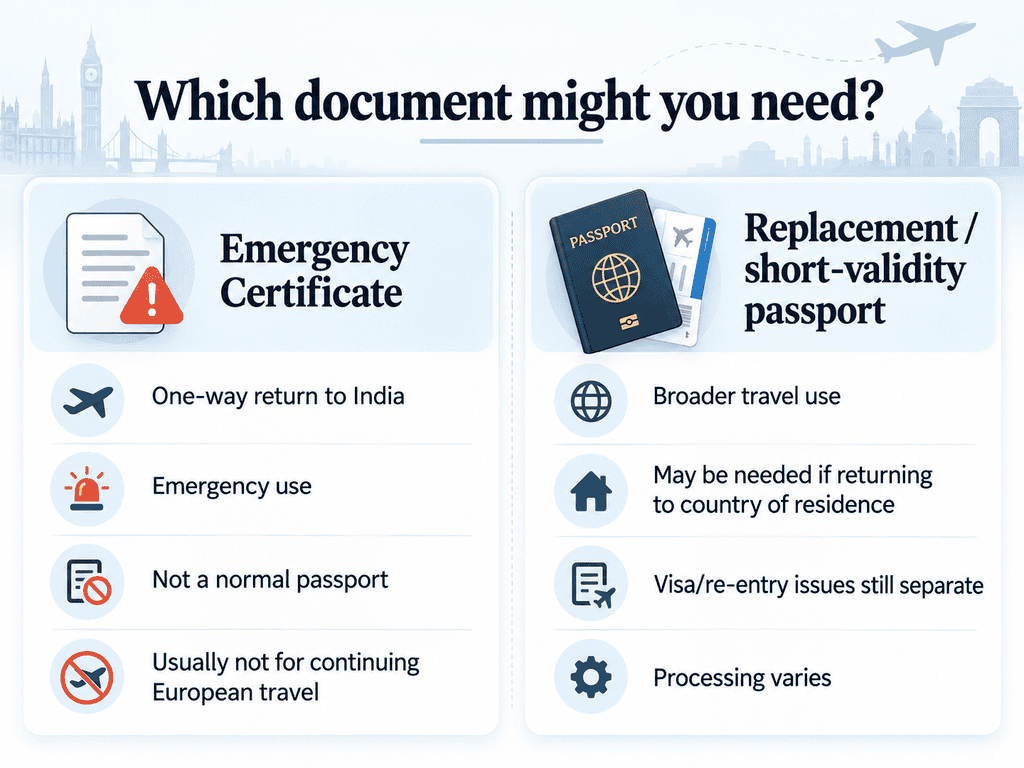
It also says a visiting tourist may instead apply for a one-year short-validity passport, currently quoting a processing time of around 10–12 working days. That processing time is specific to that mission and can change.
The four-desk problem: why everyone seems to give you a different answer
If you live abroad and lose your passport while traveling, you may actually be dealing with four different decision-makers.
1. Indian Embassy or Consulate
They answer: What Indian travel document can we issue you?
2. Authorities in the country where you currently are
They answer: What documentation do you need while remaining here or departing?
3. Immigration/border authorities of the country you need to enter
They answer: Can you enter or re-enter with the documents you now have?
4. The airline, ferry, train company or other carrier
They answer: Will we board you?
An Indian consulate cannot promise that a European immigration authority will admit you. This is normal.
An immigration authority cannot guarantee an airline’s check-in system will accept your documentation. This is normal.
The airline or the train company will ask you to contact the consulate and will not give you a firm response. This is normal.
And someone saying “I crossed the border without being checked” tells you nothing about what will happen to you tomorrow. All you can do now is tak the appropriate steps you need to take.
Can I travel within the Schengen area after losing my Indian passport?
EU guidance says that a non-EU national traveling in the EU needs a valid passport and possibly a visa. Once someone has properly entered Schengen, there are normally no routine internal border checks, but temporary controls can be introduced, and police checks can still occur. Several Schengen states currently use temporary internal border controls from time to time, and they can change. There is also the practical issue of airlines and other carriers checking identification.
Spain’s Indian mission contains an interesting but carefully worded note: a police report will sometimes be accepted by some airlines for European travel instead of a passport—but it immediately tells travellers to check with the airline before travelling. Treat that as an exception worth investigating, not permission to show up at an airport and hope.
What happened to the Schengen visa in my lost passport?
Do not assume your visa automatically transfers to your new passport. Procedures depend on which country issued it and your circumstances.
For example, the Dutch government’s NetherlandsWorldwide service currently tells holders of a lost or stolen passport containing a Dutch-issued short-stay Schengen visa to report the loss, cancel the visa, and obtain a new passport. If already inside Schengen, it directs travelers toward the relevant immigration authority for the new visa procedure.
If your Schengen visa was issued by Germany, France, Spain, or another country, contact that country’s immigration/consular authorities.
The same principle applies to non-Schengen visas. Don’t take Reddit advice saying “your old visa is definitely valid” or “definitely canceled” as authoritative. Make a phone call.
What if I have a European residence permit?
Keep it safe. A separate residence card may be crucial evidence that you legally live in that country. Indian missions themselves ask for residence permits when dealing with NRIs who lose passports. France, Belgium, Germany, and the Netherlands all include residence documentation in relevant lost-passport procedures.
But a residence permit does not automatically substitute for a passport for international travel. If you are outside your country of residence, contact that country’s immigration or border authority and ask exactly what is required for re-entry with your replacement Indian document.
My flight is tomorrow. What do I do?
First, accept the possibility that you will miss it. Sorry. But buying another ticket is better than choosing the wrong document because you are trying to save the existing booking. Spain’s Indian mission warns travelers that they “may need to arrange a new flight” to allow time to obtain travel documentation.
Do this:
- Call or email the responsible Indian mission immediately.
- Explain your travel deadline clearly.
- File the local police report.
- Prepare passport copies/details, photos and tickets.
- Ask whether EC, replacement passport or short-validity passport fits your case.
- Contact the airline before changing or purchasing flights.
- Contact your travel insurer.
If you are not getting appropriate consular assistance, MEA’s MADAD system exists for Indians abroad requiring consular assistance and allows grievances to be registered, tracked and escalated.
What documents should I prepare?
Requirements vary, but having these ready will save time:
- police report/loss report;
- copy or photo of your passport;
- passport number;
- date and place of issue;
- expiry date;
- visa copy;
- residence permit, front and back;
- proof of address in your country of residence;
- Indian IDs such as Aadhaar, PAN, voter card or driving licence if available;
- passport photographs meeting the mission’s specification;
- flight bookings;
- written explanation of the loss;
- travel insurance policy;
- documents for accompanying spouse or children if their passports are also affected.
Some missions require the passport number to appear in the police report. Germany’s consulates in Munich and Frankfurt, for example, specifically ask for this. If you know your passport number, take it with you when filing the report.
What if the embassy is closed?
Check the official mission website. Many Indian missions maintain emergency contact arrangements, but their definition of an emergency varies. Madrid explicitly lists the loss of an Indian passport by a visitor as one of the circumstances for its emergency number. Paris likewise provides an after-hours emergency number for Indian nationals in cases including passport loss or distress. The Netherlands is more restrictive about its general after-hours number and warns people not to call it for routine consular inquiries, while separately providing instructions for tourists who have lost their passports.
So don’t rely on a phone number copied from an old blog. We have come across accounts of people who were unable to reach the embassy at the listed phone numbers. However, do your best to search Indian Embassy/Consulate + [country] + lost passport / emergency and make sure the result is the mission’s official government website.
What if I find the passport after reporting it lost?
Do not immediately put it back in your pocket and fly. Whether it remains usable can depend on what has already happened in the reporting/replacement process.
One Indian traveler in Canada reported a passport lost to local police, later recovered it, and then specifically consulted Indian authorities before traveling again. In their case, they said the consular advice was that it remained valid because a replacement had not been applied for. However, once a passport has been formally canceled or a replacement process has invalidated it, finding the physical booklet again does not necessarily revive it.
Ask the Indian Mission/Post for clarification before using a recovered passport.
Can an Emergency Certificate include a connecting flight?
Ideally, no. Potentially, yes, but don’t improvise the route. Spain’s Indian mission guidance states that an EC journey to India may include a connecting flight without leaving the airport in the intermediate country. That does not automatically settle every transit-visa or carrier requirement.
When discussing the EC with the mission, show them your exact itinerary, including the transit airport. Then confirm acceptance with the airline. A direct flight to India may sometimes reduce complications.
Will travel insurance cover this?
Maybe. Policies vary enormously, but passport loss can trigger coverage for things such as:
- replacement-document fees;
- additional accommodation;
- reasonable transport to a consulate;
- changed flights;
- emergency expenses.
Insurers normally expect documentation.
That is another reason the police report, receipts, embassy correspondence, and airline documentation matter. Call the insurer early rather than assuming you can claim everything later.
If this article was not for you, still these guidelines apply for you
You cannot guarantee that your passport will never disappear. You can make the next incident dramatically less painful.
Keep secure digital copies of:
- passport bio page;
- visa pages;
- residence permit, front and back;
- Aadhaar or another Indian ID;
- travel insurance;
- itinerary.
Also, save the passport number, issue date, expiry date, and place of issue in a secure location.
Do not keep your only copy in the same backpack as the passport.
Some Indian mission guidance notes that a photocopy is not mandatory if the passport is lost, but the previous passport particulars will still be needed.
Five minutes of preparation can save hours of trying to prove who you are from outside a consulate.
Frequently asked questions
What should I do first if I lose my Indian passport abroad?
Confirm it is genuinely missing, then report the loss or theft to the local police and contact the Indian Embassy or Consulate responsible for your location. Gather copies or details of the passport, visa, residence permit and travel booking.
What is an Indian Emergency Certificate?
An Emergency Certificate, or EC, is an emergency travel document issued to qualifying Indian nationals, principally to allow a one-way return to India when a passport cannot be used or replaced in time. It is not equivalent to a normal passport.
Can I travel to another European country with an Emergency Certificate?
Do not assume so. The Indian Embassy in the Netherlands explicitly says its EC is not for visiting a third country or travelling within Europe/Schengen. If you need to return to another country where you legally reside, ask the mission about a replacement or short-validity passport instead.
I am an NRI. Do I have to return to India if my passport is lost?
Not necessarily. Your available options depend on the mission and your circumstances. France specifically provides a short-validity passport route for Indian nationals who are residents of another country, and Spain distinguishes between ECs for return to India and replacement passports for travel elsewhere.
Can I travel within Schengen with only the police report?
Do not rely on that. Routine internal border checks may be absent, but non-EU travellers still need appropriate travel documentation, temporary controls and police checks can occur, and carriers may impose document checks. Ask the relevant authorities and carrier before travelling.
What if I don’t have a copy of my passport?
Contact the Indian Mission/Post. A copy is very useful, but official Indian guidance says previous passport details and other documents establishing Indian identity can be used in some cases when the copy is unavailable.
How long does a replacement passport take?
There is no reliable worldwide answer. Verification of nationality, previous passport records and police verification can affect processing time. Individual missions publish their own estimates; for example, the Netherlands currently quotes around 10–12 working days for a tourist’s one-year short-validity passport.
What if my flight leaves tomorrow?
Be ready to book another flight at your expense. However, contact the Indian mission immediately, file a police report, and provide the mission with your exact itinerary and destination. Be prepared to change the flight. Do not choose an EC solely because it sounds faster if your actual destination is a foreign country where you reside.
Is my European residence permit enough to fly without my passport?
Usually you should not assume so. A residence permit proves residence status; a passport is a travel document. Ask the border/immigration authorities of your country of residence and the carrier what they require for your specific journey.
Who should I trust if the airline, embassy, and Reddit give different answers?
Each controls a different part of the journey. Use Indian authorities for Indian travel documents, immigration/border authorities for entry or residency questions, and the carrier for boarding requirements. Use Reddit to learn what problems other travelers encountered, not to establish your legal right to travel. This article has accumulated data from several trusted websites and stories of people like you. Our goal is to help you understand the process and approach this challenging task with a calm mind. This article should not be treated as legal or immigration advice.
The important thing to remember
A lost passport abroad feels like everything has collapsed at once. Usually it hasn’t.
You are still you. Your citizenship has not disappeared. If you are a legally resident abroad, that underlying status does not evaporate because a booklet is missing. What has changed is that you need the right documents to prove those things again.
So don’t try to solve the entire situation in your head.
Start with the police report.
Find the responsible Indian mission.
Tell them where you actually live and where you need to go.
Then work through the visa, residence and airline questions one at a time.
It may cost you a flight, a day at a consulate or an unwanted extension to your holiday.
But in most cases, this is not the end of your trip abroad.
It is paperwork.
And paperwork has a route through it.