
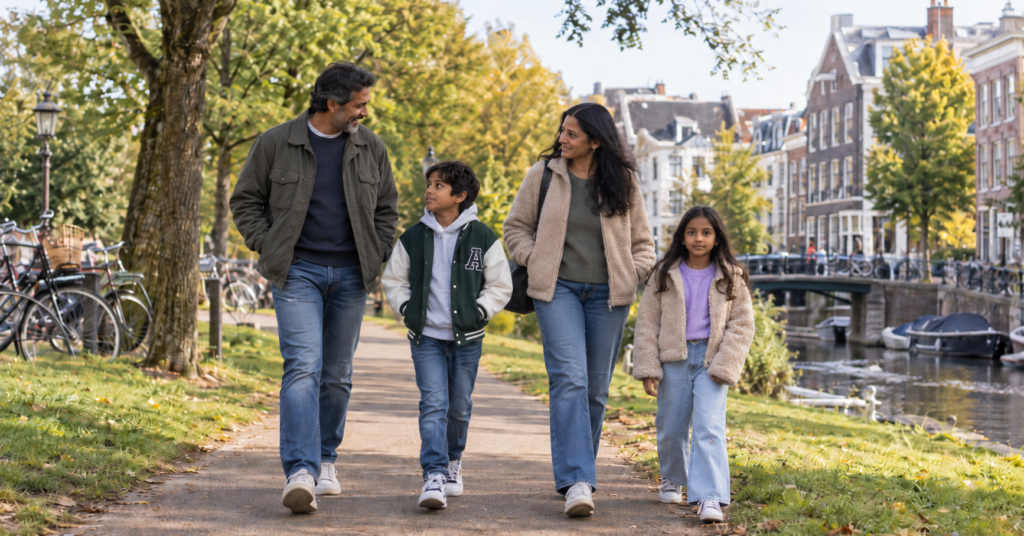
The great Indian migration boom to the Netherlands has cooled sharply. Yet another change is happening underneath the headline: Indians who arrived in earlier years are increasingly making the country their home. The result may be a community that is growing more slowly but becoming considerably more settled.
For much of the past decade, the Indian migration story in the Netherlands was easy to recognize. Generally, Indians in the Netherlands often arrive with an on-side project or a temporary job offer in technology. These highly skilled migrants move to Amsterdam, Amstelveen, or Eindhoven, mostly with their partners and families. Over the years, we have found Indians complaining about “too many Indians” moving after them. However, we have found the statistics moving in two different directions at once.
Far fewer Indians are being added to the Dutch population through migration than just a few years ago. Yet Indians who arrived in earlier cohorts are much more likely to remain in the Netherlands for the longer term.
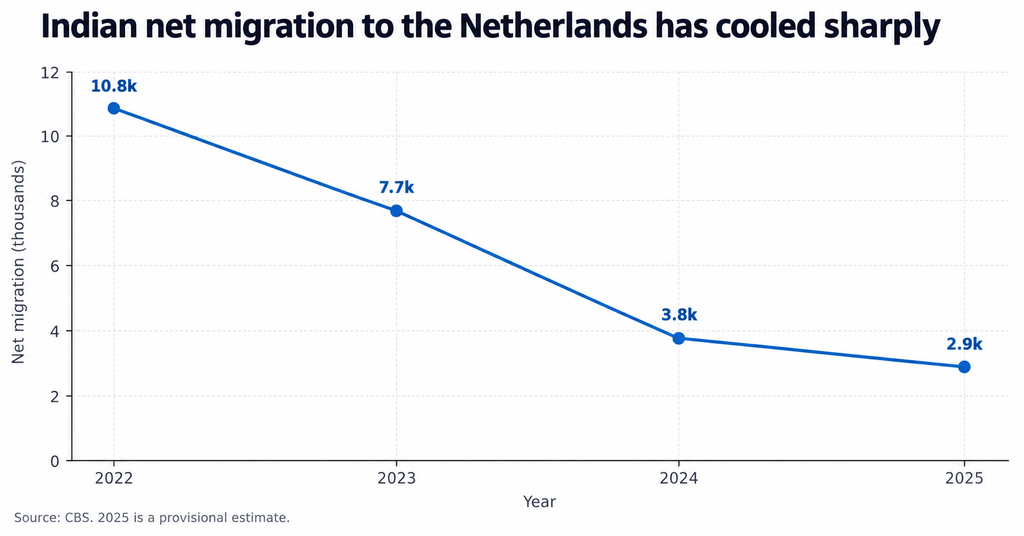
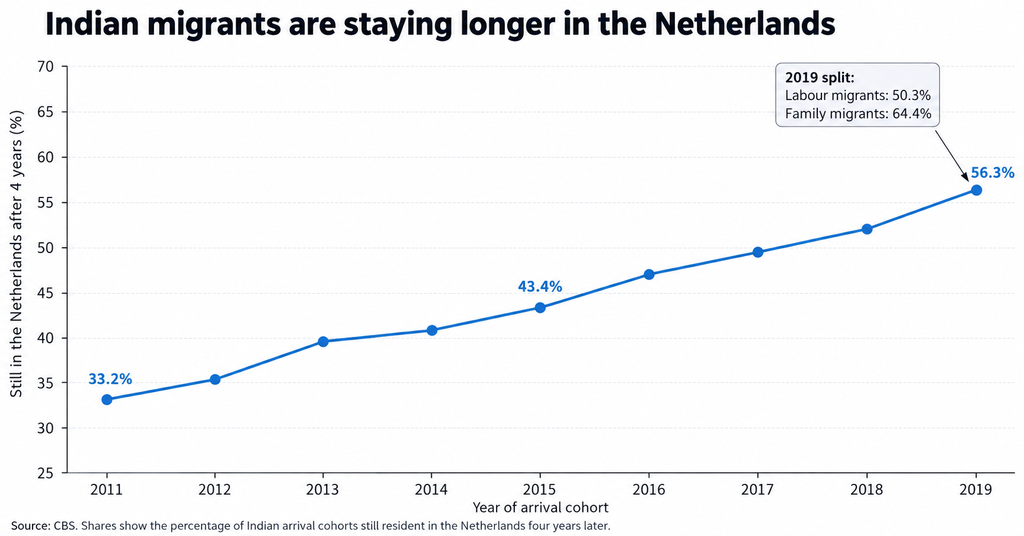
In 2022, net migration from India was around 10,800 people. By 2025, it had fallen to roughly 2,900—a decline of about 73 percent. In the first half of 2026, net Indian migration slipped again to around 1,000, compared with 1,100 in the same period of 2025. At the same time, Statistics Netherlands (CBS) has found something almost opposite happening among people already here. Of Indians who arrived in the Netherlands in 2011, only about 33 percent were still here four years later. For the 2019 arrival cohort, that figure had climbed to 56 percent. Among family migrants in the 2019 cohort, almost 64 percent remained after four years.
The flow is shrinking. The roots appear to be getting deeper.
The Indian migration boom has cooled
In 2022, around 14,755 people of Indian origin arrived in the Netherlands and 3,852 left. By 2024, immigration had fallen to 9,392 while emigration had risen to 5,411. Net migration consequently dropped from almost 10,900 to around 4,000 in only two years. CBS’s subsequent estimate puts 2025 net migration even lower, at about 2,900.
| Period | Net migration from India |
|---|---|
| 2022 | +10,800 |
| 2023 | +7,700 |
| 2024 | +3,800 |
| 2025* | +2,900 |
| First half 2026* | +1,000 |
One major part of this slowdown is visible in the highly skilled migration route. Across all non-EU countries, the Netherlands received about 26,200 knowledge migrants in 2022. By 2025, that number had almost halved to 13,900. CBS specifically says the decline included substantially fewer highly skilled migrants from India. That matters because Indian labour migration to the Netherlands has historically been unusually concentrated in knowledge work, particularly IT. It would be tempting to produce a neat explanation involving the Dutch economy, hiring conditions, tax rules or migration policy. The available data does not justify a single cause that cleanly. What it does establish is simpler: the knowledge-migrant pipeline that fuelled much of the Indian boom is much smaller than it was at its 2022 peak.
But Indians who arrived earlier are staying much longer
This is where the story becomes more interesting than “fewer Indians are moving to the Netherlands”. CBS followed different Indian arrival cohorts and checked how many were still living in the country four years later. The progression is remarkably consistent. Among the 2011 cohort, 33 percent remained after four years. That rose to 40 percent for those arriving in 2013, 43 percent in 2015, nearly 50 percent in 2017 and 56 percent among those who came in 2019.
And migration type matters. For the 2019 cohort, 64.4% of family migrants were still in the Netherlands after four years. 50.3% of labour migrants were still here. CBS itself suggests that the increasing duration of stay may partly reflect Indians living in family settings more often than before: families are generally less likely to emigrate than people living alone.
However, these figures do not indicate whether the Indians arriving in 2024, 2025, or 2026 will also continue to stay in the country. Four-year retention statistics necessarily lag several years behind current migration. The newest Indian cohort CBS could observe for four full years was the 2019 cohort.
Family has quietly become a bigger part of the story
In 2013, work clearly dominated Indian migration to the Netherlands: 49 percent of arrivals came for labour and 37 percent for family reasons. Ten years later, that relationship had reversed. In 2023, 45 percent of Indian immigrants came for family reasons, compared with about 40 percent for work and 15 percent for study.
By 1 January 2024, the Netherlands had 89,276 residents with India as their country of origin. Almost 74,000 had been born in India—but another 15,579 had been born in the Netherlands to one or two India-born parents.
And the community is geographically concentrated. Amsterdam had around 11,000 residents of Indian origin in early 2024. Amstelveen had about 6,500 and by far the highest concentration—roughly 68 per 1,000 residents. Uithoorn, Eindhoven and Almere also stood out. This increasingly looks less like a temporary workforce distributed around offices and more like the early architecture of a settled diaspora.
Housing stops being only about the commute
A temporary worker can optimize for proximity to the office, furnished rent, and flexibility. A family expecting to remain for ten years starts asking different questions: How many bedrooms? Which neighbourhood? Which school? Can grandparents stay comfortably? Is buying preferable to renting? Those decisions arrive in one of Europe’s difficult housing markets. The average transaction price of an existing Dutch owner-occupied home reached €480,000 in 2025. But a community staying longer will inevitably interact differently with housing than one largely expecting to leave.
The school question changes too
Nearly 16,000 residents of Indian origin were already born in the Netherlands by the beginning of 2024. Previously, most of them preferred international schools, however, with families expecting their children to grow up in the Netherlands are increasingly prioritizing Dutch schools, encouraging their children to develop a fluency in the language, make friends in the neighborhoods, and integrate better.
Cultural infrastructure starts mattering differently
Amstelveen offers a glimpse of what a mature community can look like. Its annual Diwali Festival reached its 17th edition in 2025 and attracts thousands of visitors from Amstelveen, Amsterdam, and surrounding municipalities. That is no longer a one-off “expat event”. It is part of the cultural calendar of a Dutch municipality. A more settled population can also create demand beyond big festivals.
What happens At around five years?
For many migrants, five years in the Netherlands is an important threshold: under the standard naturalisation route, applicants generally need at least five consecutive years of lawful residence, alongside residence-status, integration and other requirements. For Indian citizens, that decision carries an additional weight.
India does not permit dual citizenship in this situation. The Indian Embassy in The Hague states that when an Indian citizen acquires a foreign nationality, Indian nationality terminates under Section 9 of the Citizenship Act, and the Indian passport must be surrendered. An eligible former Indian citizen can subsequently obtain OCI status, but OCI itself is not dual citizenship and does not confer political rights such as voting. This turns naturalization into something more emotionally and practically complicated than simply upgrading a residence permit.
And again, recent community conversations reflect the shift. One Netherlands resident who had lived here since 2020 wrote this year about being eligible for Dutch citizenship but weighing the advantages against surrendering the Indian passport and going through the OCI process. Another Indian family considering a move to the Netherlands with a toddler said that one of its biggest attractions was the possibility of their son eventually obtaining a Dutch passport, even though they saw little immediate financial upside to relocating.
Reddit is not representative research. But notice how far these questions have moved beyond salary, relocation allowances and the 30% ruling.
They are questions about where a family belongs.
So has the Indian community moved from temporary expats to settled families?
Not entirely.
The Netherlands still receives Indian students and knowledge workers who may stay only a few years. Even among the 2019 cohort, 44 percent had left within four years. Half of the Indian labor migrants in that cohort were gone by then.
New Indian migration has dropped sharply. Earlier cohorts are staying much longer. Family migration had overtaken labour migration by 2023. Nearly 16,000 residents of Indian origin were already Netherlands-born by 2024.
This complicates politically loaded discussions about highly skilled migrants to another level. The community may have entered another stage of migration. So, rather than looking at the statistics around new HSM visa issues, it might help analyze what is happening with home ownership, school enrollments, new children born, businesses being started, and everything this chain of events eventually impacts.
Sadly, we could not find data about these. But we can conclude that the Indian migration boom may be cooling. The Indian-Dutch community is not disappearing with it. Its time horizon is getting longer.
Sources
- Statistics Netherlands (CBS). Population growth slows for third consecutive year, February 2026 — annual migration and 2025 India net-migration figures. View CBS source
- Statistics Netherlands (CBS). Migrants from India are staying longer in the Netherlands, March 2025 — migration motives, retention, immigration/emigration and municipal distribution. View CBS India analysis
- Statistics Netherlands (CBS). Immigration down in 2025, especially asylum and knowledge migrants, June 2026 — decline in highly skilled migration, including from India. View CBS source
- Statistics Netherlands (CBS). Population growth slowed in the first half of 2026, July 2026 — first-half Indian net migration. View CBS source
- Statistics Netherlands (CBS). Population by country of origin and birthplace — Indian-origin population and Netherlands-born residents. View CBS table
- IND. Becoming a Dutch national through naturalisation, updated August 2026. View IND guidance
- Embassy of India, The Hague. Renunciation / Surrendering of Indian Citizenship. View Embassy guidance
- IND. Residence permit Article 8 ECHR family life, updated July 2026. View IND guidance
- CBS/Kadaster. Average home cost €480 thousand in 2025. View housing data