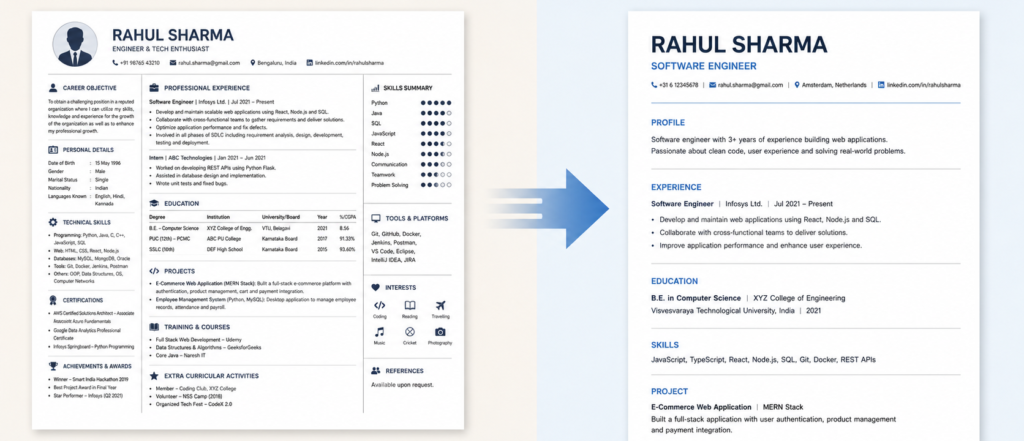
Many Indian students and early-career professionals arrive in the Netherlands with a CV that feels complete by Indian standards: detailed education history, projects, internships, certifications, achievements, maybe even marks and school-level details. The problem is that Dutch recruiters usually need something simpler: a clear, scannable document that quickly shows what role you fit, what you have done, what skills you bring, and whether you can legally work.
What dutch recruiters expect?
The purpose of your resume is first to judge if they should make a quick 5 minute call to schedule an interview or not. Only in later rounds of interviews, it begins a way to drive the conversation forward. Your resume will perform well if within 10 seconds, it immediately shows whether you might be a fit or not. The recommendations below drive from that motivation.
What to include at the top?
The header of your resume should indicate your name, phone, email, location, and work authorization. You would ideally use the profile section to clearly mention the roles you want to target. For Indian readers, “work authorization” is highly important as it immediately informs the recruiter that they do not have to worry about initiating the process later. Keep it factual and mention whether you are on an orientation year visa, or are already a highly skilled migrant, or have a valid residence permit through your spouse. If you will need work permit, clearly mention “Work Permit Required”.
Avoid
Hardworking, motivated, dynamic individual seeking challenging opportunity at XYZ Company.
Use
MSc Data Science graduate in Den Haag with internship experience in Python, SQL, and dashboard development. Interested in junior data analyst roles in healthcare, sustainability, or logistics.
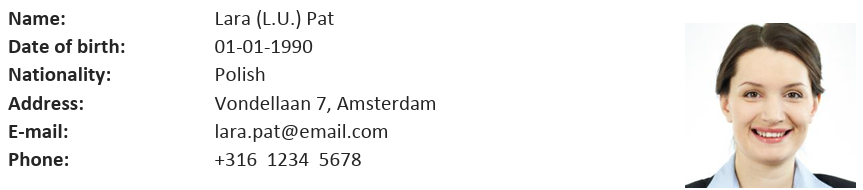
Source: https://beeldbank.uva.nl/m/7307260acd47bc52/original/Voorbeeld-cv.pdf
Photo or no photo?
Adding a professional photograph in your resume helps make a good impression. Most good CVs we have reviewed include a photo, but do not think about it as a mandatory requirement. If you do not have a high quality professional photo, a clean no-photo CV is usually safer and keeps attention on skills especially in corporate, tech, analytics, finance, or university-related roles.
Showcasing your Experience
Experience: What to Write When You Do Not Have Much Experience Yet
This is the section where many first-time job applicants panic.
You open a blank CV, stare at the word “Experience,” and think:
“But I am applying for my first job. What experience?”
Fair. But also: not entirely true.
For a first job in the Netherlands, “experience” does not only mean full-time employment. It can include internships, university projects, thesis work, part-time jobs, volunteering, freelance work, student association work, hackathons, case competitions, open-source contributions, teaching assistant roles, or even serious self-initiated projects.
The trick is not to pretend you have more experience than you do. The trick is to describe your actual experience in a way that makes sense to an employer.
The main rule: do not list tasks, show relevance
A common mistake is writing experience like this:
Worked on a machine learning project.
Helped with research.
Made reports.
Was responsible for communication.
This sounds vague because it does not tell the recruiter what you actually did, what tools you used, what problem you worked on, or why it mattered.
A better version is:
Built a Python-based model to classify customer feedback into complaint categories using pandas and scikit-learn. Cleaned 3,000+ records, tested multiple models, and presented results in a short dashboard.
Same experience. Much stronger signal.
Think in this format
For each role, project, or internship, try to answer four questions:
What was the context?
What company, course, project, client, team, or problem were you working with?
What did you do?
Use active verbs: built, analyzed, designed, coordinated, tested, researched, improved, wrote, presented, supported.
What tools or methods did you use?
Mention relevant tools only. Python, Excel, SQL, Figma, Power BI, SPSS, AutoCAD, SolidWorks, Google Analytics, stakeholder interviews, literature review, lab testing, customer research, etc.
What came out of it?
A report, prototype, dashboard, model, presentation, recommendation, cost saving, improved process, user insight, grade, client feedback, or measurable result.
You do not always need numbers. But when you have numbers, use them.
What if you do not have experience?
Many Indian students underestimate university projects because they are not “real jobs.” Dutch employers often care less about whether the work happened in a big company and more about whether it shows practical ability.
Use projects, internships, thesis, student assistant roles, hackathons, volunteering, part-time work, and university assignments. The trick is to translate them into employer language: problem, tools, action, result.
Avoid
Completed a group project on sustainability.
Use
Worked in a team of four to analyze sustainability reporting practices of Dutch retail companies. Compared public ESG reports, summarized findings, and presented recommendations for improving transparency.
What if your experience is from India?
Use it. But translate it for the Dutch reader. Do not assume the recruiter understands the company, college, job title, exam system, or market context. Add a few words of explanation where needed. Avoid unexplained abbreviations. Dutch recruiters do not have time to decode your CV like a puzzle.
Avoid
- Worked as BDE intern at EdTech company.
- Worked on machine learning project using Python and different algorithms.
Use
- Business Development Intern at an early-stage edtech startup.
- Researched 40+ potential school partners, prepared outreach material, and supported founder-led sales conversations.
- Built a deep neural network based classification model to predict customer churn using pandas, scikit-learn, and logistic regression; improved model accuracy from 71% to 82% after feature selection.
A simple structure you can use
For each experience entry, use this format:
Role / Project Title
Organization or University | City/Country | Month Year – Month Year
Then add 2–4 bullets.
Each bullet should ideally start with a strong verb:
- Built
- Analyzed
- Designed
- Coordinated
- Researched
- Presented
- Improved
- Supported
- Tested
- Created
- Managed
- Developed
Example:
Data Analysis Project
ABC Institute of Engineering | Mumbai, India| Feb 2025 – Apr 2025
- Analyzed student performance data using Python and pandas to identify patterns in course engagement.
- Created visual summaries in Power BI to show weekly activity trends.
- Presented findings to a group of 20 classmates and received feedback on improving dashboard clarity.
Before and after: Indian CV to Dutch-style CV
Before:
I was part of a team project where we studied the marketing strategy of a company and made a presentation. I contributed to the research and helped prepare slides.
After:
Researched the marketing strategy of a Dutch consumer brand as part of a four-member university project. Analyzed competitors, summarized customer segments, and co-presented recommendations using a 12-slide presentation.
The second version is shorter, clearer, and more professional. It removes the drama and keeps the evidence.
Instead of saying “hardworking,” write what you completed.
Instead of saying “team player,” describe how you worked in a team.
Instead of saying “quick learner,” mention the tool, method, or task you learned and applied.
What if you really have nothing?
Then build something small before applying. You do not need a giant portfolio or a series of github repositories, but just one or two concrete projects that match the jobs you want.
For example:
If you want a data analyst job, analyze a public dataset and create a simple dashboard.
If you want a marketing job, audit three Dutch brands and write a short campaign analysis.
If you want a UX role, redesign one confusing website flow and explain your decisions.
If you want a policy or research role, write a two-page evidence summary on a relevant topic.
If you want a finance role, build a basic valuation or budgeting model.
Your CV becomes stronger when it contains evidence that you can do the work, not just interest in the work.
Education Section
If you do not have years of work experience yet, your degree, thesis, projects, courses, grades, and academic activities help recruiters understand what kind of candidate you are. But there is one important warning: your education section should not look like your entire academic life story. Your CV is not the place to list every school, every subject, every certificate, every workshop, and every event you participated in. The goal is simply to show the education that is relevant to the job you want.
Use reverse chronological order. That means your latest degree comes first. Do not start with your 10th standard, 12th standard, school board, or childhood academic achievements unless there is a very specific reason.
Good things to include:
- Relevant coursework: Mention 4–6 subjects that match the job.
- Thesis or major project: Especially useful if it connects to the role.
- Tools and methods: For technical, analytical, design, research, or business roles.
- Academic distinction or strong grade: Include it only if it is genuinely strong or requested.
Other Relevant Sections
Interests, Extracurriculars, and Achievements
Interests and Extracurriculars can often help you look more human or more relevant. You can mention Student association leadership, Volunteering, Sports, Hackathons, Public speaking, Community organizing. Do not write about passive hobbies like listening to music, watching movies or travelling.
Certifications help if you want to show relevance to the job you are applying for. Remember not every Coursera course you completed deserves space in your CV. If you have a series of certifications from a learning path, highlight the most advance ones.
Achievements often add proof of your expertise if they are relevant to the job you are applying for. You can talk about academic awards, competition wins, scholarships, and other forms of measurable outcomes. Remove school-level awards unless exceptional.
Languages
This is an important section if you are applying for jobs that require knowledge of Dutch or other languages, or may require frequent interaction with clients or collaborators from other countries. Cover English fluency, Dutch level, or indicate if you are actively learning Dutch for a course or towards a certification. Avoid writing “basic Dutch” if you hold a conversation for more than half a minute. Be honest, but do not apologize for it.
Final check
Before you upload your CV and hope for the best, pause for ten minutes. Let us fix those before a recruiter sees them. Open your CV and look at it like a tired recruiter. Can someone understand these things in ten seconds?
- Who are you?
- What kind of role are you applying for?
- What is your most relevant education?
- What experience, internship, or project makes you credible?
- What skills/tools do you actually bring?
- Are you already in the Netherlands?
- Can you legally work, or do you need sponsorship?
Many applicants lose because the CV doesn’t match the job. They prepare one general CV and send it everywhere: data analyst, business analyst, marketing intern, operations trainee, product role, consulting role, and maybe also “anything related to management.” That usually does not work.
Before applying, compare your CV with the vacancy.
- Does your CV reflect the role title?
- Have you included relevant keywords from the job description?
- Are the most relevant projects and skills easy to find?
- Have you removed unrelated details that distract from the role?
You do not need to rewrite your whole CV for every job. But you should adjust the profile, skills, and top bullets so the match is obvious.
One last useful question
Before sending, ask yourself: “If a recruiter only reads the top half of my CV, would they understand why I am relevant for this role?”
If not, fix the top half. Because that is where the first shortlist decision often happens.