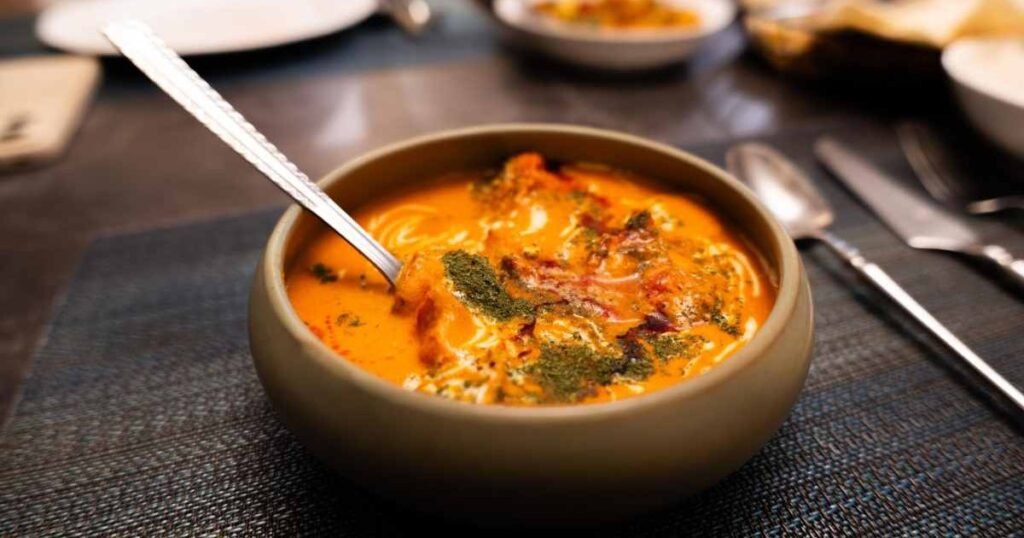
You might make better butter chicken at home. But could you sell it for €15, pay Amsterdam wages and rent, and still have money left at the end of the month? We followed the numbers.
Imagine you’ve opened a small Indian restaurant in Amsterdam. Your butter chicken is excellent. Your friends love it, your mother approves, and even your Dutch neighbour has stopped asking whether it’s supposed to be that spicy.
You put it on the menu for €15.
A customer orders one. The kitchen prepares it, someone packs it, and the food leaves the restaurant. Fifteen euros earned. Not bad for some chicken, tomatoes, cream and spices, right?
Except the chicken wasn’t free. Neither was the cook, the gas, the kitchen, the cardboard container or the person who cleaned the pan. The landlord expects rent whether you sell five curries or fifty.
And if the customer ordered through a delivery platform, another company wants a share.
So how much of that €15 actually survives?
1. First, the government takes a bite
Before we buy a single tomato, we need to deal with VAT. In the Netherlands, restaurant food and takeaway meals generally carry 9% VAT, according to the Dutch Tax Administration. So when someone pays €15 for butter chicken, the restaurant’s sales revenue, excluding VAT, is about €13.76. The remaining €1.24 is VAT collected from the customer.
Where the money goes
Illustrative figures; not actual business accounts.
That doesn’t mean the restaurant pays €1.24 in net VAT to the government on every curry. Businesses can generally offset eligible VAT paid on purchases against VAT collected on sales. But for understanding the economics of a menu item, €13.76 is the correct starting point.
Now comes the cooking.
2. How much does butter chicken actually cost?
The chicken is probably the most expensive ingredient. Then come tomatoes, onions, cream, butter, yoghurt, spices and the inevitable handful of coriander. A restaurant, however, doesn’t shop like a household. It buys larger quantities, prepares sauces in batches and tries to use ingredients across multiple dishes.For our hypothetical restaurant, let’s budget €3.20 for one portion.
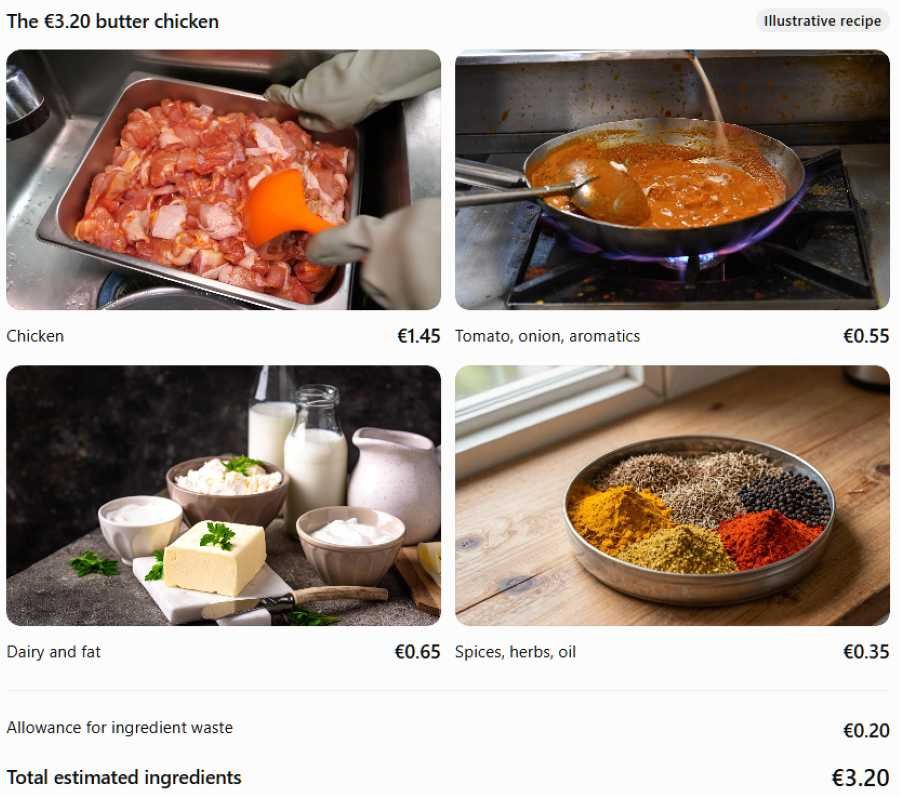
That leaves €10.56 after ingredients and VAT. At first glance, that’s encouraging. The raw ingredients consume only about 23% of the restaurant’s revenue from the dish. But there is a problem with treating that €10.56 as profit: somebody has to turn those ingredients into dinner.
3. The expensive ingredient you cannot see: time
Cooking one portion of butter chicken doesn’t necessarily take long if the sauce is already prepared. But preparing that sauce, marinating the meat, cleaning equipment, and handling orders all require paid working hours. In a restaurant, you’re not just paying someone for the minutes they spend stirring your curry. You’re paying for the shift.
A cook might be busy for three hours, then have an unexpectedly quiet evening. The wages still need to be paid. For our model, let’s allocate €4.20 in labor to each curry sold. That includes a share of preparation, cooking, cleaning and service, with employer costs included. The figure is an assumption, not a universal cost per dish. In practice, labor must be allocated across all the food and drinks sold during a shift. And that brings us to one of the most important numbers in the restaurant business: how many customers show up.
The Dutch hospitality wage agreement gives us a useful reality check. From July 2026, the basic gross hourly wage for an adult worker aged 21 or older starts at €14.99, while experienced cooks can fall into higher pay groups. Employer contributions, holiday pay and other employment costs make the actual expense greater than the hourly wage alone.
And when the owner works in the kitchen personally? That doesn’t make the labor economically free. It means the owner is supplying it.
4. Where your €15 actually goes
Here is our model for one butter chicken sold directly to a customer, either at the counter or in the restaurant. It assumes a €15 curry without rice or naan, a €3.20 ingredient cost, and a modest allocation of operating expenses.
Where the money goes
Illustrative figures; not actual business accounts.
In this scenario, just €1.76 remains. That’s about 12.8% of revenue excluding VAT, before financing costs, depreciation, income tax, and any owner compensation not already included in labor. Even this figure is optimistic if the restaurant has borrowed heavily to renovate its premises or has a bad month.
But there’s another way that €1.76 can disappear almost instantly.
5. Your curry has a new business partner: the delivery app
Imagine that the same customer orders the curry through a delivery platform. The restaurant still buys the ingredients and prepares the meal. It now also needs takeaway packaging. And depending on its contract, it pays a commission to the platform.
Dutch reporting summarised by MenuThere describes historical Thuisbezorgd commission arrangements of approximately 14% for restaurants handling their own delivery and around 30% when platform couriers deliver. Actual contractual rates can differ. Let’s use a 30% commission as a scenario, calculated here on the €15 food price, solely to demonstrate the impact.
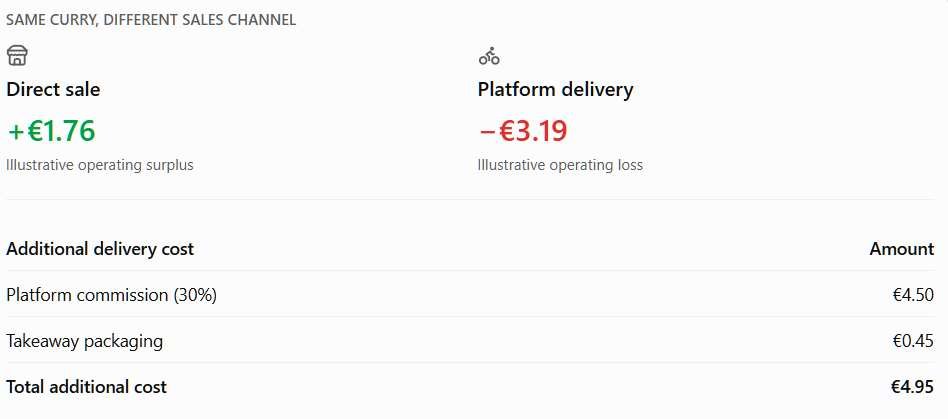
This doesn’t mean every delivery order loses money. A restaurant may charge more on the app, use spare kitchen capacity, receive a larger order with several dishes, or operate with much lower rent and staffing costs. The distinction is between contribution and allocated profit. An additional order can contribute towards rent already being paid, even if it appears unprofitable after allocating all fixed costs. Still, a restaurant that relies heavily on delivery platforms has to understand exactly what those orders contribute. More orders are not automatically better business. For customers, there is a simple implication: ordering directly from a restaurant can leave more of the food bill with the business, although the restaurant may still have its own delivery and payment costs.
6. The real boss of the restaurant might be the rent
Now imagine two equally talented cooks. One opens a restaurant on a busy Amsterdam shopping street. The other opens a small takeaway kitchen in a less expensive neighborhood. They buy similar ingredients and sell similar curries. Yet their businesses can have completely different economics.
Our model allocated €2.20 of each curry to rent and property costs. But that number depends heavily on sales volume.
Suppose the restaurant pays €3,300 per month in rent and related property costs. That’s a hypothetical budget, not a verified Amsterdam rental quotation. How many curries does it take to pay €3,300 in rent?
Curries Needed to be Sold Everyday to Cover Rent
Move the slider to see how fixed property costs change per sale. Actual restaurants sell a mix of dishes and drinks, so this is a simplified sales-equivalent model.
Opening the restaurant can be expensive before the first customer arrives, too. The Dutch Chamber of Commerce, KVK, says hospitality entrepreneurs may need operating permits, food-safety arrangements, financing, and suitable premises. Its 2026 guidance lists a broad €500–€3,500 range for an operating permit, depending on circumstances. There are other complications. A premises may require renovation, ventilation upgrades or kitchen equipment. An alcohol license introduces additional requirements. And none of these costs guarantees a customer will walk through the door.
The restaurant owner, it turns out, is also a property negotiator, purchasing manager, employer, and part-time administrator.
7. Why the family-run restaurant is a different kind of business
Consider a small restaurant run by a couple. One cooks, the other handles customers, orders, stock, and accounts. Perhaps relatives help during busy periods. Compared with a restaurant that hires separate employees for every function, this arrangement can reduce immediate payroll expenses and provide flexibility.
But there’s a catch.
If the owner works sixty hours a week and takes home €2,000 a month, the business may be paying less than the economic value of that work. A restaurant can be cash-flow positive while delivering a disappointing return on its owners’ time and investment. That distinction matters particularly for aspiring entrepreneurs who compare restaurant earnings to those of a salaried career.
So an owner isn’t simply worried whether the restaurant will make money. They are more concerned about how much they, the owner, finally earn per hour after accounting for the capital and the risk they have put into it. Family involvement can be a genuine competitive advantage. Shared trust, accumulated recipes, flexible responsibilities, and continuity can help a small business operate efficiently. But it should not be confused with unlimited free labor.
8. Could serving something other than butter chicken be the smartest move?
Walk through Indian restaurant menus in Amsterdam, and you’ll encounter familiar names: butter chicken, chicken tikka masala, biryani, naan, paneer, and various curries. There’s a commercial reason for offering familiar dishes. Customers recognize them. They know what to expect, and they’re more likely to order without needing an explanation.
But familiarity also creates competition. If several nearby restaurants sell a similar butter chicken, customers can compare prices, ratings, portion sizes, and delivery times. A new restaurant may struggle to stand out. What if it specializes instead?
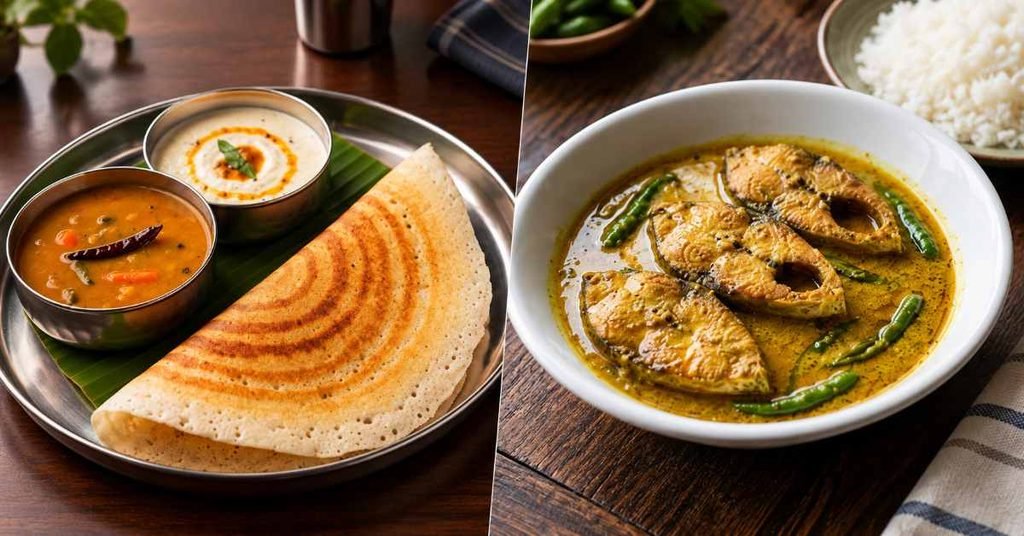
A Bengali fish curry or a lesser-known regional dish could attract curious diners, but may require more explanation and carry uncertain demand.
A specialized restaurant might benefit from fewer ingredients, a clearer brand, and customers who cannot easily find the same food elsewhere. Yet specialization is not automatically profitable. Imported ingredients can cost more, unfamiliar dishes may sell slowly, and a narrow menu can limit demand. The commercial challenge is to find the intersection between food that is distinctive, food that customers want, and food that can be produced efficiently.
For a new Indian entrepreneur, the question may be less about whether Amsterdam needs another Indian restaurant and more about whether it needs a particular kind of Indian restaurant.
9. So, can an Indian restaurant in Amsterdam make money?
Yes. But excellent cooking is only one requirement.
In our model, the direct sale of curry leaves is €1.76 before accounting for other business costs. Increase sales volume, improve purchasing, build a loyal customer base, or sell complementary items, and the picture can improve. Reduce customer traffic, increase labor requirements, or rely heavily on expensive delivery channels, and it can deteriorate quickly.
The Netherlands had 50,320 registered hospitality businesses at the beginning of 2026, according to KVK. That tells us the industry is substantial, not that every establishment is profitable. And CBS figures show Dutch hospitality turnover grew in 2025. Rising sales across an industry, however, do not tell us how much individual restaurant owners take home. Our hypothetical restaurant has taught us something more useful than a single profit percentage: its success depends on dozens of small decisions that customers rarely see.
How many dishes can one cook in an hour? How much food is wasted? Which menu items sell together? How much does the restaurant spend acquiring a new customer? How many quiet Tuesdays can it survive?
These questions may matter more to its survival than whether the butter chicken is the best in the neighborhood.
And perhaps that’s the real secret behind a €15 curry.
You might be able to cook it better at home. But the person selling it has to make sure the kitchen is still open tomorrow.
Sources
Belastingdienst 9% VAT on restaurant food and takeaway
Koninklijke Horeca Nederland July 2026 hospitality wage tables
KVK, Business setup, permits and operating requirements
CBS, 2025 Dutch hospitality turnover figures
MenuThere, Secondary reporting on historical platform commissions; needs direct contract verification