A funded PhD in Europe can be financially comfortable. It can also leave you wondering where €3,000 disappeared every month. For Indian applicants, the useful number isn't the salary advertised in the vacancy. It's what remains after Europe has taken its share.
An Indian master’s student looking at a Dutch PhD vacancy might see €3,204 per month and instinctively translate it into rupees. Suddenly, a doctorate looks less like four years of student life and more like a surprisingly well-paid European job. That instinct isn’t completely wrong. In the Netherlands, many PhD candidates really are university employees. In Germany, doctoral researchers commonly receive public-sector employment contracts. Belgian PhD scholarships can provide a respectable tax-free net income.
But three numbers matter more than the headline salary: what actually reaches your account, what housing costs in your city, and what kind of contract you have. And those three numbers can turn apparently similar PhD offers into very different financial lives.
don’t compare the advertised salaries
Here is roughly what three common 2026 arrangements look like.
| Netherlands | Germany | Belgium | |
|---|---|---|---|
| Typical arrangement | University employee | Employee or scholarship | Often doctoral scholarship |
| Example starting income | €3,204 gross/month | 65% TV-L E13: about €3,712 gross/month | Around €2,600–€2,700 net at major Flemish universities |
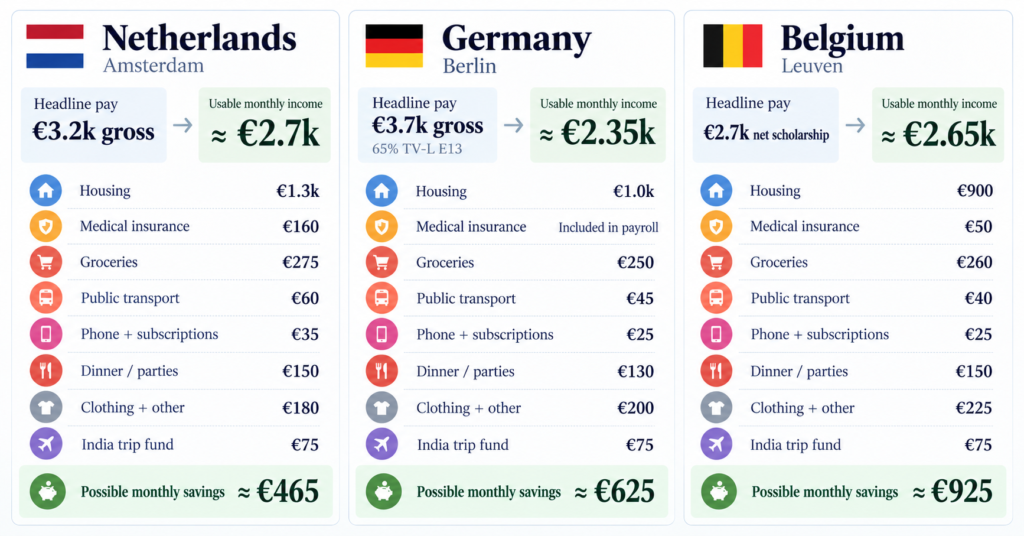
| Approx. money reaching you | Around €2,700 before separate Dutch health insurance* | Around €2,350–€2,400 in a common single-person case* | Around €2,600–€2,700 in a common scholarship case* |
| Biggest financial variable | Housing | City + contract percentage | Housing + scholarship conditions |
*Illustrative, not a personal salary calculation. Tax status, family situation, pension arrangements, and other deductions change the result.
Dutch university PhDs currently move through a national salary scale from €3,204 in year one to €4,051 in year four, and university contracts typically add 8% holiday pay and an 8.3% year-end payment. A published 2026 salary-table calculation puts the first-year €3,204 salary at roughly €2,734 net.
Germany looks higher on paper, but the code in the vacancy matters. The German Research Foundation says Research Training Group positions generally range from 65% to 100% of TV-L E13. At the current 2026 rate, 65% of E13 at the first experience step is about €3,712 gross; one calculator scenario for a single employee with public insurance and supplementary pension leaves roughly €2,359 net.
In Belgium, meanwhile, a scholarship may have no conventional gross salary worth comparing at all. Ghent University’s 2026 figures show approximately €2,678 net per month for an unmarried doctoral scholarship holder with no children and zero recognised seniority. Qualifying doctoral scholarships may be exempt from Belgian personal income tax while still subject to social security deductions. That is why “Which country pays PhDs the most?” is often the wrong question.
The Netherlands: your landlord may determine your savings rate
Consider a first-year Dutch PhD taking home roughly €2,700. Utrecht University’s private-market guidance puts rooms at roughly €500–€1,000 and studios at €750–€1,700 per month. Basic Dutch health insurance averages another €157 per month in 2026. Here is a realistic illustrative budget:
| Monthly expense | Shared room | Own studio |
|---|---|---|
| Housing/utilities | €850 | €1,300 |
| Health insurance | €157 | €157 |
| Groceries/household | €325 | €325 |
| Transport/bicycle | €75 | €75 |
| Phone/subscriptions | €35 | €35 |
| Eating out/social life | €200 | €200 |
| India-trip fund | €75 | €75 |
| Miscellaneous/emergency | €150 | €150 |
| Total | €1,867 | €2,317 |
| Left from €2,734 | €867 | €417 |
And that difference—roughly €450 every month—comes almost entirely from housing.
A recent Asian PhD researcher in the Netherlands described receiving around €2,500 net, paying €1,300 for a small studio and managing to save only about €200. The discussion quickly filled with people whose finances looked completely different because they shared accommodation or paid much lower rent. In the Netherlands, your housing decision can matter more to your savings than your salary.
There is also one unusually important question for someone recruited directly from India: ask HR about the Dutch expat scheme. Scientific researchers at qualifying institutions may be exempt from the normal salary threshold, provided the other conditions are met, and in 2026 the maximum tax-free reimbursement remains at 30%. It is not automatic; the employer has to apply. That can materially change the calculation.
Germany: what on earth does “65% E13” mean?
German PhD advertisements occasionally appear to have been written for people who already understand German payroll bureaucracy. A vacancy might simply say: TV-L E13, 65%. E13 is the public-sector pay grade. The 65% is the fraction of the full E13 salary attached to your contract, not the percentage you keep after tax. For a 2026 first-step E13 position, 65% currently works out to around €3,712 gross per month. After tax, health insurance, pension, unemployment insurance and other deductions, a representative single-person calculation lands around €2,350–€2,400.
Unlike in the Netherlands, statutory health insurance contributions are already included in those payroll deductions. DAAD estimates the average student living costs in Germany at roughly €900–€1,200 per month, while noting that rent varies widely by location. A doctoral researcher sharing a flat in a moderately priced university town can therefore build meaningful savings. Someone insisting on their own apartment in Munich, Berlin or another tight housing market may see a very different result. Also, don’t ignore that German rentals commonly require a deposit of around three months’ basic rent, and apartments may arrive surprisingly unfurnished.
Belgium: less obvious salary, surprisingly solid disposable income
Belgium is easy to overlook in Indian “PhD abroad” conversations, but financially, it can be attractive. Ghent University currently estimates living costs for one person at roughly €1,200–€1,800 per month, including accommodation and ordinary expenses. A private studio or small flat is estimated at €700–€1,050, while shared accommodation can be €400-€650. Put that beside a typical doctoral scholarship of around €2,600-€2,700 net, and the arithmetic can be quite favorable. The important word, however, is scholarship. At institutions such as Ghent and KU Leuven, qualifying doctoral scholarships may be exempt from personal income tax while remaining subject to social security rules. That makes comparing a Belgian scholarship with a German or Dutch gross salary almost meaningless.
So can you send money home to India?
Yes, sometimes quite comfortably. But there is a difference between being financially independent of your parents and being able to support them financially. For someone living alone in an expensive Dutch city, a recurring €400–€500 remittance could consume almost everything left after normal expenses. The same amount may be much easier for someone sharing housing in Ghent or a cheaper German university city. If your family relies on you financially, calculate the PhD offer in this order:
Net income → rent → unavoidable insurance → normal living costs → emergency fund → annual India travel → family remittance → actual savings.
A recent Indian student considering a European doctorate described exactly this anxiety: whether a funded PhD abroad was a route to financial freedom or a “financial trap for a middle-class family”, particularly when supporting parents remained part of the equation.
WHAT THIS MEANS
If you need to send a fixed amount home every month, put it into your spreadsheet before accepting the PhD. Do not treat remittances as whatever happens to remain at the end.
The money you need before your first salary
This is the part many “fully funded PhD” calculations miss. Being fully funded does not mean arriving in Europe costs nothing. You may need money for:
- your flight from India;
- temporary accommodation;
- first month’s rent;
- one to three months’ rental deposit;
- furniture, bedding, and basic household items;
- residence or administrative costs;
- several weeks of expenses before everything is operational.
In Utrecht, for example, deposits of one or two months’ rent are common on the private market. Germany typically requires about 3 months of rent as a deposit. Belgian deposits can reach two months for student contracts and three months for other contracts.
Practical rule: unless university housing is already secured, arriving with only enough money to survive until your first salary is risky. Having roughly two to three months of expected living costs plus your housing deposit gives you considerably more room to deal with the landing.
Is a European PhD financially worth it, then?
If the question is “Can I live independently without my parents financing me?”, funded PhDs in these three countries can generally make that possible.
If the question is “Can I save, travel to India once a year, and occasionally send money home?”, often yes—but housing determines much of the answer.
If the question is “Is doing a PhD the best way to maximize my earnings in my twenties?”, that is a different calculation. A four-year doctorate has an opportunity cost compared with entering the industry after a master’s degree.