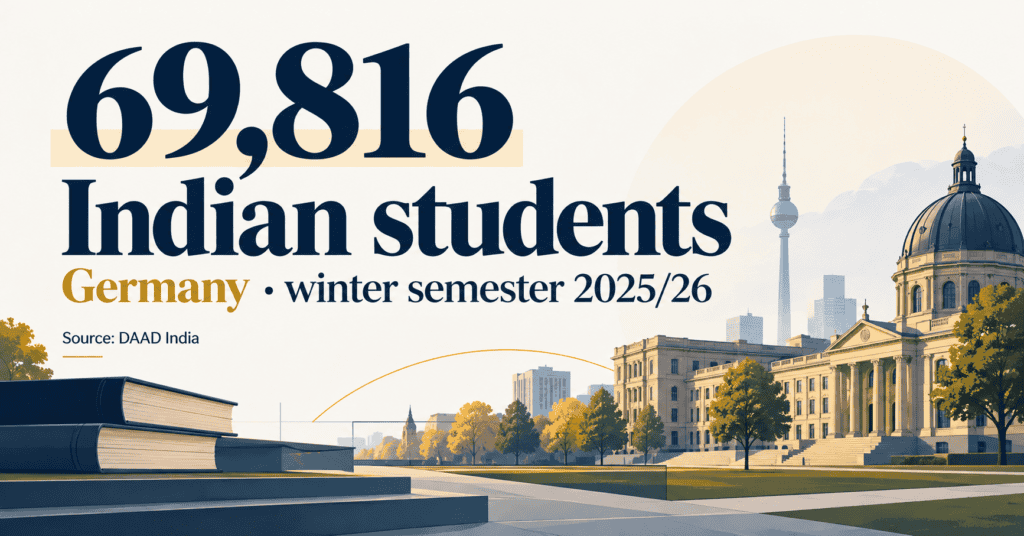
Germany is attracting record numbers of international students and Indians are now its largest group of foreign students in the country. Graduates can stay 18 months to look for work. There is just one complication: the job market has become much tougher.
If you spend enough time on Indian study-abroad forums, Germany currently appears to exist in two parallel universes. In universe one, Germany desperately needs workers. Tuition is low. The population is aging. Companies need engineers. International graduates get 18 months to find employment. Learn German, work hard, settle down.
In universe two, Nobody is hiring. Graduates send hundreds of applications. English-speaking tech jobs have disappeared. Employers want experience. German is no longer “optional”. Return tickets to India are beginning to look surprisingly attractive. The frustrating thing is that both versions contain some truth.
Germany still has a serious long-term need for skilled migration. It is also experiencing a weak labor market right now. That distinction matters if you’re considering spending two years and a significant amount of money on a German master’s degree.
THE NUMBERS IN 20 SECONDS
59,419 — Indian students in Germany in winter 2024/25
~420,000 — estimated international students and doctoral candidates in winter 2025/26
18 months — post-study job-search period available to qualifying non-EU graduates
6.5% — German unemployment rate in August 2026
335,000 — unemployed university-educated people in 2025
157 — occupations still classified as shortage occupations
Sources: DAAD, German Federal Employment Agency, Make it in Germany.
Indians really are moving to Germany in huge numbers
India has become Germany’s single largest source country for international university students. In the 2024/25 winter semester, 59,419 Indian students were enrolled at German universities—about 20% more than the previous year. International enrolment overall has continued growing. DAAD estimated around 420,000 international students and doctoral candidates in Germany during the 2025/26 winter semester.
Germany offers internationally recognised universities, many low- or no-tuition public programmes, an expanding range of English-taught degrees and a comparatively attractive post-study immigration route. For a non-EU graduate of a German university, the government currently allows a residence permit for up to 18 months to look for qualified employment. During that search period, graduates can take other employment to support themselves. On paper, that’s a pretty good deal. The problem is that a residence permit gives you time to find a job. It does not create the job.
Germany’s labour market has cooled
In August 2026, Germany had just over 3.06 million unemployed people, with the national unemployment rate at 6.5%. The Federal Employment Agency described the labour market as showing little momentum. For university-educated workers, the shift has been particularly noticeable. The number of unemployed people with university-level qualifications reached 335,000 in 2025, according to the Federal Employment Agency—a record high and an increase of 16% in a year.
That number does not mean 335,000 international graduates failed to find jobs. It covers unemployed academics generally, across Germany. The agency also notes that part of the increase relates to highly educated refugees whose labour-market integration can take time. Still, the direction is hard to ignore. Graduating into Germany in 2026 is not the same proposition as graduating into Germany during a hiring boom.

But wait. Doesn’t Germany have a massive skills shortage?
Yes. This is where the story becomes more interesting.
Germany still identified 157 occupational categories with skilled-worker shortages in 2025. Roughly half of registered skilled vacancies were in shortage occupations. Foreign workers are increasingly important as older German workers retire. But “Germany has a worker shortage” does not mean that Germany has a shortage of every graduate with a master’s degree.
This is where nuances become an important consideration. The strongest shortages remain in areas such as healthcare and nursing, construction and skilled trades, professional driving, childcare and selected technical and social occupations. One particularly relevant detail for Indian students considering tech. Software development was no longer classified as a shortage occupation in the 2025 analysis. That doesn’t mean software jobs have vanished. It means “Germany needs IT people” is no longer a sufficient career strategy.
Reddit has noticed
A recent post in an Indian study-abroad community attracted considerable attention after an Indian professional in Germany pushed back against the constant stream of “Should I move to Germany for a master’s?” questions. The author’s view was blunt: applicants with meaningful domain experience had a much stronger case than fresh graduates expecting a master’s degree to automatically unlock employment in Germany.
However it is important to consider this as just one person’s experience. But the frustration underneath it is worth taking seriously. A lot of students appear to be evaluating Germany by considering that they obtain a degree from a German university, followed by an 18 month visa. As there is a shortage of skilled workers, they will easily find a job in the country within this grace period. However, this process is not a guarantee.
English gets you through university. German may get you through the labour market.
Germany has deliberately expanded English-language education. That has made it much easier for international students to enter without already speaking advanced German. But studying in English and building a career in Germany are different problems. Even Germany’s official Opportunity Card information says German is recommended because it improves job-search prospects, even in cases where applicants do not legally need German to qualify for the visa.
The effect varies dramatically by occupation. An experienced AI engineer joining an international company in Berlin may spend their entire working day in English. A mechanical engineer dealing with suppliers in Baden-Württemberg may not. A marketing graduate, HR professional, healthcare worker or client-facing consultant may discover that language changes the size of the accessible market completely. This is why asking: “Can I get a job in Germany without German?” isn’t particularly useful. The better question is: “How many employers in my exact field, city and experience level will hire me without German?” Very different question.
The master’s degree is not the product. Your employability is.
This sounds obvious, but study-abroad marketing can reverse the logic. The degree gets treated as the destination. Get admission. Get visa. Reach Germany. The actual destination is usually employment. So evaluate the employment market before choosing the programme.
Before commiting to migrating to the country, you have to consider the following:
Your experience
Two applicants with the same master’s degree can enter very different job markets if one has four years of industry experience and the other has none.
Your field
Germany can simultaneously have severe nursing shortages and a weak junior software market.
Your German
“I’m planning to learn after I arrive” is a plan. It is not yet a skill.
Your university and programme
Does it include industry projects, internships or local-company relationships?
Your city
Berlin’s English-speaking labor market is not representative of every German city.
Your finances
Could you sustain yourself for months after graduation while searching?
So is Germany still worth it?
For plenty of people, yes. The country still offers something unusually attractive. Germany’s demographic problem did not disappear because the economy slowed. The Federal Employment Agency explicitly says immigration will become more important as the workforce ages. But there is an important difference between Germany needs skilled workers and Germany needs me, immediately after my master’s, in English, in the city I prefer, at the salary I expect. The first statement can be true while the second is false.
The new rule for studying abroad
Ten years ago, “study in Germany and find a job afterwards” may have felt like a strategy. In 2026, it is better treated as a hypothesis. Before spending the money, test it. Search actual job advertisements. Count how many fit you. Look at the language requirements. Talk to graduates from the programme—not university ambassadors. Ask what happened to the international students who didn’t land the glamorous LinkedIn job. Then decide.
Germany is not closed. Germany is not a guaranteed immigration hack either. And perhaps that is the most useful thing an Indian student can know before boarding the flight.