Before last week’s Indian restaurant arrests, there was a chef shortage, a special immigration route, warnings of exploitation, a government shutdown — and even a lawsuit by Asian restaurant owners. The full story goes back years.
There is a deceptively simple question behind the Indian restaurant investigation currently making news in the Netherlands:
Why was there a special immigration scheme for Asian restaurant chefs in the first place?
The answer begins not with crime, but with dinner.
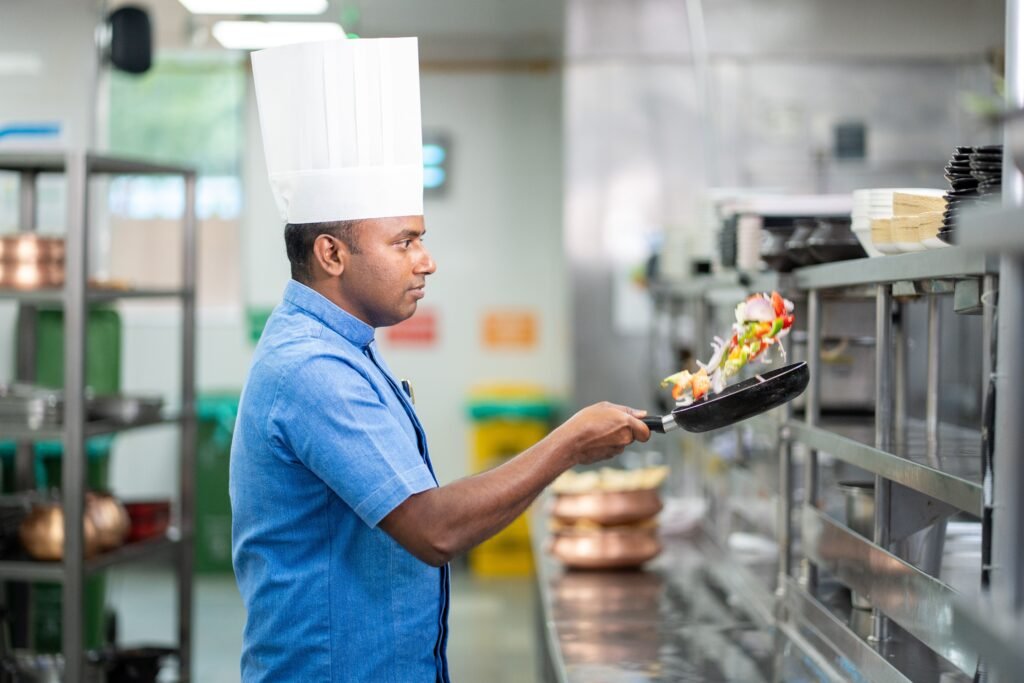
A good specialist kitchen needs specialist cooks.
Knowing how to make a passable curry is not necessarily the same thing as running a Chettinad, Sichuan, Thai or Japanese kitchen professionally. Asian restaurant owners argued for years that the Dutch labour market simply did not contain enough appropriately trained cooks.
The Dutch government agreed.
And that created one of the more unusual corners of Dutch immigration policy: special treatment for the Asian catering industry.
What happened next is a case study in how a sensible policy can create very different incentives once visas, labour shortages, employers and vulnerable migrants enter the same kitchen.
First, the problem: “We can’t find the cooks”
Under normal Dutch labour-migration rules, an employer wanting to hire someone from outside the EU often has to demonstrate that suitable labour could not reasonably be found in the Netherlands, EU/EEA or Switzerland.
Asian restaurants were given an easier route.
Between October 2019 and October 2022, a structural arrangement allowed qualifying Asian restaurants to obtain work permits for specialised cooks more easily. The broader policy had developed from earlier agreements between the industry and government.
The restaurant sector argued that authenticity sometimes required knowledge extending beyond generic cooking skills — including specialised recipes, techniques and knowledge of particular cuisines.
Even after the special arrangement disappeared, that argument did not disappear with it.
In a 2025 court case, Asian restaurant organisations argued that losing their exceptional position could make it substantially harder to recruit cooks from Asia and potentially threaten the viability of restaurants dependent on specialist culinary skills.
That is not an absurd concern.
But another problem was developing simultaneously.
2020–21: The warning signs become difficult to ignore
During the pandemic, restaurants across the Netherlands were closed or operating under heavy restrictions.
Yet investigative journalists at Investico, working with Trouw and De Groene Amsterdammer, found that the IND had issued more than 500 new work visas for Asian catering workers after the start of the pandemic.
Some newly arrived workers reportedly landed at a nearly deserted Schiphol only to discover that the promised work had disappeared or that they would earn considerably less than expected.
For a Dutch employee, a bad restaurant job can mean finding another restaurant.
For a newly arrived worker whose presence in the country is connected with a specific employer and work permit, the calculation can be very different.
The Labour Authority started a dedicated Asian-catering project in 2020 together with the IND and UWV.
And then came the numbers.
THE NUMBER THAT CHANGED THE DEBATE
In 2021 and 2022, the Labour Authority inspected 50 employers that had applied for GVVA permits under the Asian catering arrangement.
It deliberately used two groups:
- 25 businesses selected because inspectors saw risk indicators
- 22 businesses selected randomly
- the remaining cases did not fall neatly into those completed comparison groups.
Violations were found at:
60% of the risk-selected businesses
and, perhaps more surprisingly,
45% of the randomly selected businesses.
That second number mattered.
If problems only appeared at businesses inspectors already suspected, the government could argue that enforcement needed improving.
But nearly half of a random sample showing violations suggested something broader.
Across 27 employers, inspectors recorded 111 violation findings, resulting in 76 fine reports and 35 warnings. Violations involved rules covering foreign workers, minimum wages and working hours.
Some employers were associated with much more serious suspicions, including human trafficking and illegal employment.
The special scheme was no longer being discussed only as a solution to a chef shortage.
It was increasingly being discussed as a vulnerability.
2022: The Netherlands pulls the plug
From 1 January 2022, the special route had already been stopped for new applications from abroad.
In November that year, the Dutch government decided it would not return.
The Labour Authority’s findings played a central role.
Then-Social Affairs Minister Karien van Gennip argued that it was inappropriate to continue facilitating a sector through special rules when inspections were revealing violations and misuse on that scale.
That did not mean Asian restaurants were banned from bringing cooks from Asia.
They could still use the normal system.
But they would generally have to meet the same labour-market requirements as other employers — including demonstrating recruitment efforts within the Netherlands and Europe.
Existing transitional arrangements continued for a period, and the remaining exceptional position finally disappeared on 1 July 2024.
Then the restaurants took the government to court
This is the chapter most people following last week’s arrests probably haven’t heard about.
Asian restaurant organisations did not simply accept the end of the scheme.
In 2024, several restaurant companies and industry groups sued the Dutch state.
The plaintiffs included organisations representing Chinese and Thai restaurants and the South Asian Cuisine Association.
Their basic concern was simple: without the old rules, could restaurants still realistically recruit the specialist chefs their cuisines required?
They asked, among other things, for temporary restoration of the earlier treatment of applications and compensation from the state.
The state pushed back.
It pointed directly to the Labour Authority’s findings and argued that the exceptional scheme had risked facilitating rather than preventing abuses.
It sounds like the setup for a major legal ruling on whether the government had been right to abolish the scheme.
That ruling never really happened.
In May 2025, the District Court of The Hague decided that the plaintiffs had come to the wrong court.
Individual restaurant owners could challenge rejected permit applications through administrative-law procedures. The civil court therefore declared their claims inadmissible without deciding the central policy argument on its merits.
In other words: the restaurants didn’t exactly lose the argument. The court declined to have that argument there.
And then came September 2026
Fast-forward sixteen months.
Dutch authorities arrested two owners of eight restaurants belonging to three international Indian restaurant chains.
Investigators say those chains had obtained more than 70 GVVA permits through the old Asian catering arrangements.
Some people brought to the Netherlands as specialist cooks allegedly ended up washing dishes, cleaning, waiting tables or managing restaurants.
Workers allegedly worked 60–80 hours per week, often over six or seven days, without being paid for the additional hours.
Investigators estimate more than €4 million in unlawful benefit may have been generated. They are also examining alleged bond contracts, pressure on families in India and threats of violence.
The suspects have not been convicted, and prosecutors will ultimately have to prove whatever charges they decide to bring.
Still, the historical parallel is difficult to miss.
The same policy created to solve the specialist-chef shortage was abolished partly because inspectors feared it could facilitate worker exploitation.
Four years later, investigators allege that three Indian restaurant chains systematically misused that very system.
TIMELINE: HOW WE GOT HERE
2019
A structural Asian catering arrangement makes it easier for restaurants to recruit specialist cooks from outside Europe.
2020
The Labour Authority starts a dedicated project investigating possible misuse.
2021
Investigative reporting describes Asian cooks arriving during the pandemic and encountering missing work, lower pay and dependence on employers.
January 2022
New access to the exceptional scheme is stopped.
November 2022
The government decides the special arrangement will not return after inspectors find high violation rates.
July 2024
The remaining exceptional treatment ends.
May 2025
Asian restaurant organisations, including the South Asian Cuisine Association, lose their civil-court route to challenge the policy change; the court does not decide the underlying policy dispute.
September 2026
Two owners of eight restaurants are arrested in a major investigation into alleged exploitation and migrant smuggling.
So was the scheme simply a bad idea?
That conclusion is tempting. It is also too easy.
There really can be shortages of specialist cooks.
A restaurant serving a particular regional cuisine may genuinely need skills that aren’t widely available in the local labour market. Treating every specialist-chef application as suspicious would punish legitimate businesses — including many immigrant-owned restaurants operating perfectly normally.
The deeper problem is dependency.
The more that one employer determines whether a worker can enter the country, earn money, stay legally employed and sometimes even find housing, the more costly it becomes for that worker to challenge the employer.
Most employers will never abuse that power.
The important policy question is what happens when someone does.
And that brings us to the most human part of this story.
Because “why didn’t they just leave?” sounds obvious only until you understand what leaving can actually mean.