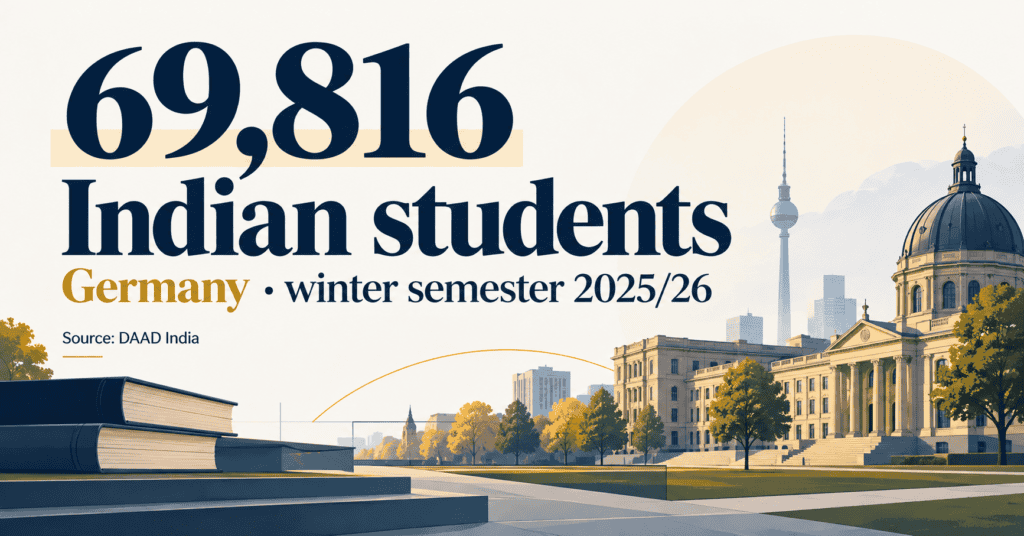
Germany is actively courting Indian students and skilled workers. At the same time, many 2027 Master’s applicants now face an extra academic test before their APS paperwork can be completed. The first dMAT takes place tomorrow — and applicants are still working out whether they need it at all.
On Saturday, 26 September, the first group of Indian students will sit Germany’s new digital Master Test, or dMAT. The rule, announced by APS India in June, applies to selected Master’s applicants whose previous degree falls under Engineering, Commerce, Accounting, Finance, or Economics, or Business and Management. It covers applications connected to the Summer Semester 2027 and later intakes. The fee is €150.
The important nuance: dMAT is not a replacement for APS, nor is it a simple pass-or-fail exam for obtaining an APS certificate. It is an additional academic aptitude test. Applicants take a core module measuring cognitive and analytical skills and a General Academic Module focused on applying those skills to academic problems. The result is reflected on the APS certificate.
A low score does not automatically mean APS rejection. But universities are free to decide how they use the result in admissions. The certificate reports a score and percentile rank, providing universities with a standardized result they can consider.
There are also significant exemptions. If you completed your APS online registration before 29 June 2026, shipped your complete APS documents before that date, or have already completed the APS process and received your certificate, you do not need dMAT retrospectively for that completed procedure. Bachelor’s and PhD applicants are also outside the current requirement.
Why are applicants still confused?
Because the dividing lines are not intuitive. A July Reddit post from an engineering graduate captures the problem. He had registered for APS on 29 June, received his certificate in July, and planned to apply for Winter 2027. The official guidance states that applicants who have already received their APS certificate do not need the dMAT for that completed procedure. Yet on 23 and 24 September — two days before the first test — new commenters were still arriving with essentially the same question: “Same situation. Did you get any answer?”
Other threads ask whether someone targeting Winter 2027 can take the September test, whether the score expires, and whether APS documents can be sent before dMAT results arrive.
Those questions now have clearer official answers. Winter 2027 is included. A September 2026 dMAT result remains valid for Winter 2027, and the certificate itself is generally valid indefinitely. Applicants who need dMAT may send their APS documents before the score is available, but APS cannot complete the procedure until the dMAT certificate arrives.
For anyone who did not register for tomorrow’s test, there is another complication: registration closed on 15 September. The next dMAT is planned for the first quarter of 2027, but no exact date has been announced yet.
Germany wants Indian students. It is also adding another gate.
Indian students are no longer a small group in Germany’s international education strategy. DAAD recorded 59,419 Indian students at German higher education institutions in winter 2024/25, making India the largest country of origin. In January 2026, Chancellor Friedrich Merz explicitly said Germany wanted to encourage more Indian students and skilled workers, linking education to the country’s need for qualified professionals.
Germany’s message, then, is not “please stop coming.” It is closer to: come, but expect a more structured screening process.
The dMAT does not close the route to a German Master’s. But for many Indian applicants, it adds another credential, another fee, another deadline, and another place where timing can go wrong. That sits awkwardly beside Germany’s broader effort to make itself more attractive to Indian talent.
The €150 fee is not enormous compared to the overall cost of moving between countries, but it adds to APS, language tests, university application fees, visa costs, and proof of finances. One Indian applicant recently estimated spending or committing around €15,400 through the application and arrival process. Most of that, about €12,153 in their case, was blocked-account money, not a permanent expense. Germany’s official 2026 financial-proof benchmark for students is €11,904 for one year. For families planning in rupees, the issue is therefore less the single €150 charge than the accumulation of steps.
Germany is not closing the door to Indian students. It is making the door more carefully controlled.
What should a 2027 applicant do now?
First, do not assume that “2027 applicant” automatically means dMAT. Check the date and status of your APS procedure, then check whether your previous degree appears in the affected-field list. Interdisciplinary degrees such as Business Analytics, Engineering Management, Data Science or FinTech can be less obvious, so use the APS classification rather than guessing from the course title.
Second, if you already hold an APS certificate, the official guidance states that you do not need to take the dMAT retrospectively for that procedure. If you are applying for Winter 2027 and do need dMAT, the requirement still applies; Summer 2027 is simply where the new system begins.
And if you missed the September sitting, watch for the confirmed Q1 2027 date rather than waiting until university deadlines are close. The first dMAT may be tomorrow, but the larger lesson is already clear: Germany remains one of Europe’s biggest destinations for Indian students, but “low tuition” has never meant “low-friction application.”
Sources
APS India — official dMAT guidance and exemptions
dMAT — official FAQ for Indian graduate applicants
DAAD — India Country Report 2025
German Federal Government — Chancellor Merz’s January 2026 India statement